When we talk about longevity and anti-aging, the conversation usually revolves around diet, supplements, sleep optimization, and hormone balance. Biohackers and health enthusiasts will debate the merits of cold plunges, red light therapy, and advanced cardiovascular protocols to add healthy years to their lives.
But what if I told you that one of the most critical factors determining your lifespan is currently sitting in your closet?
It sounds dramatic, but it is an undeniable biological reality: the shoes you wear every day have a direct, profound impact on how long you will live. To understand this, we have to look at the number one threat to an aging body. It isn’t necessarily a sudden heart attack or a mysterious illness. For millions of older adults, the most dangerous, life-altering event they will ever experience is a simple fall.
In this comprehensive guide, we are going to explore the hidden biomechanical link between your footwear, your posture, and your lifespan. We will uncover how modern, traditional shoes are actively weakening your legs and ankles, setting you up for devastating injuries, and how transitioning to barefoot-style footwear like Xero Shoes can literally rebuild your foundation, bulletproof your balance, and keep you moving strongly for decades to come.
Chapter 1: The Biomechanics of Aging and Mobility
In the human body, mobility equals life. The phrase “use it or lose it” is not just a catchy saying; it is a physiological law known as Wolff’s Law, which states that your bones and tissues will adapt to the loads under which they are placed. If you stop moving, your body assumes you no longer need your muscles and bones, and it begins to dismantle them.
At the very foundation of your mobility is your foot. The human foot is a mechanical masterpiece. Each foot contains 26 bones, 33 joints, and over 100 muscles, tendons, and ligaments. More importantly, the soles of your feet are packed with thousands of nerve endings designed to send rapid-fire feedback to your brain about your environment. This is called proprioception—your body’s ability to sense its location, movements, and actions in space.
When you have strong feet and sharp proprioception, you have excellent balance. When you have weak feet and poor proprioception, you become a fall risk.
Chapter 2: How Traditional Shoes Destroy Your Foundation
For the vast majority of human history, we walked barefoot or wore thin leather moccasins that allowed our feet to move naturally. It is only in the last few decades that we decided to encase our feet in thick, rigid, elevated, highly-cushioned modern shoes.
While they might look stylish or feel “cloud-like” initially, traditional running shoes, dress shoes, and everyday sneakers are actively sabotaging your biomechanics in three major ways:
1. The Elevated Heel Destroys Posture
Almost all traditional shoes have an elevated heel (where the heel is significantly higher than the toes). Even standard athletic sneakers have a “heel drop” of 10 to 12 millimeters. When your heel is elevated, your center of gravity is forced forward. To prevent yourself from falling flat on your face, your body has to compensate. You tilt your pelvis forward, arch your lower back, and lock your knees. This chronic misalignment completely destroys your natural posture, leading to lower back pain, tight hip flexors, and a forward-head posture that ages your spine prematurely. Furthermore, constantly wearing an elevated heel physically shortens your calf muscles and your Achilles tendon, severely limiting your ankle mobility.
2. The Narrow Toe Box Ruins Your Balance
Look at a baby’s foot—the toes naturally splay out wider than the ball of the foot. Now look at a traditional shoe—it tapers into a point, squeezing your toes together. Your toes, especially your big toe, are supposed to act like the wide base of a tripod, gripping the earth and stabilizing your body weight. When your toes are squished into a narrow toe box, you lose your structural base. You become top-heavy and unstable, relying entirely on your ankles to keep you upright, which leads to rolled ankles and poor lateral balance.
3. Rigid Soles and Arch Support Cause Atrophy
If you break your arm, the doctor puts it in a rigid cast. When the cast comes off six weeks later, your arm is weak, shriveled, and atrophied because the muscles weren’t allowed to move. Traditional shoes with stiff soles, heavy cushioning, and artificial “arch support” act as a permanent cast for your foot. Because the shoe is doing all the work of holding your foot up, the intrinsic muscles, tendons, and ligaments in your feet and ankles simply turn off. Over years and decades, your feet become incredibly weak, lazy, and highly prone to injury.
Chapter 3: The Deadly Domino Effect of Weak Feet
This is where the connection to longevity becomes terrifyingly clear. When you spend decades wearing shoes that destroy your posture, shorten your tendons, turn off your foot muscles, and block the sensory nerves on the soles of your feet from feeling the ground, you create a recipe for disaster as you age.
As we get older, our natural muscle mass decreases (sarcopenia). If you combine age-related muscle loss with feet and ankles that have been artificially weakened by bad shoes, you lose your ability to balance. You lose your agility. If you step off a curb wrong, or slip on a slick floor, your weakened ankles cannot catch you. Your brain, deprived of sensory feedback through thick rubber soles, cannot react fast enough to correct your center of gravity.
You fall.
In the elderly population, falls are devastating. A fall often leads to a hip fracture or a shattered femur. Once an older adult suffers a hip fracture, the statistics are grim. They are forced into immobilization, which causes rapid, systemic muscle atrophy. Being bedridden increases the risk of pneumonia, blood clots, and depression. A staggering percentage of older adults who suffer a hip fracture pass away within the first 12 months following the injury due to these cascading complications.
The shoes you wear dictate your foot strength. Your foot strength dictates your balance. Your balance prevents falls. Preventing falls keeps you mobile, active, and alive.
Ready to Rebuild Your Foundation and Bulletproof Your Body?
If you want to reverse the damage caused by modern footwear, regain your natural posture, and build ankles of steel that will keep you confidently on your feet for decades to come, it is time to make the switch to barefoot-style footwear.
👉 Upgrade Your Footwear and Get Xero Shoes Here:
Chapter 4: The Barefoot Movement & Reversing the Damage
The good news is that the human body is incredibly resilient. No matter your age, you can reverse the muscular atrophy in your feet and ankles by changing the environment you put them in.
This is where the “barefoot” or minimalist shoe movement comes in. The goal of a barefoot shoe is not to force you to walk around with no shoes on, but rather to provide a protective layer for your foot without interfering with its natural biomechanics.
True minimalist shoes, like those engineered by Xero Shoes, are designed with three non-negotiable principles:
- Zero-Drop (Completely Flat): The heel and the ball of the foot are on the exact same level. This immediately restores your center of gravity, naturally aligns your pelvis and spine, and allows your Achilles tendon to lengthen back to its biological norm.
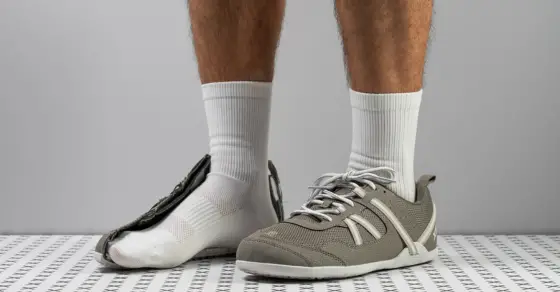
- A Wide, Anatomical Toe Box: The front of the shoe is shaped like an actual human foot. It gives your toes the space they need to splay out completely flat, restoring the “tripod” base of support and vastly improving your structural stability.
- Ultra-Flexible, Thin Soles: The sole of the shoe bends and flexes in every direction your foot naturally moves. It provides protection from glass and hot pavement, but it does not act like a cast.
Chapter 5: How Xero Shoes Keep You Stronger, Longer
When you ditch your heavily cushioned sneakers and transition to Xero Shoes, the physiological changes in your lower body are profound. Here is how they actively contribute to a longer, healthier, more active lifespan:
Activating the Kinetic Chain
Because Xero Shoes do not have artificial arch support, the muscles in your feet are finally forced to wake up and support your body weight. With every step you take, you are micro-dosing strength training to the 100+ muscles and ligaments in your feet and lower legs. Over time, your foot arch strengthens, your ankles become incredibly robust, and your calf muscles regain their natural functional power.
Bulletproofing Your Balance
The thin, flexible soles of Xero Shoes allow the thousands of nerve endings on the bottom of your feet to finally “feel” the ground again. This sensory feedback is immediately transmitted to your brain, telling it exactly what angle your joints are at and what type of terrain you are navigating. This massively enhances your proprioception. When your brain knows exactly where your body is in space, your reaction times improve drastically. If you happen to stumble, your newly strengthened ankles and hyper-aware nervous system can easily correct your balance before you ever hit the ground.
Realigning Your Posture
When you remove the elevated heel, your body naturally stacks itself the way gravity intended. Your hips tuck back into a neutral position, taking the pressure off your lower lumbar spine. Your shoulders naturally pull back, and your head sits squarely over your shoulders rather than jutting forward. By fixing your posture from the ground up, you reduce chronic pain, improve your breathing mechanics, and reduce the wear-and-tear on your joints that causes premature aging.
Chapter 6: A Biohacker’s Guide to Safely Transitioning
If you have worn traditional, elevated, highly-cushioned shoes for your entire life, your feet are currently weak. You cannot simply buy a pair of Xero Shoes and immediately go run a 5k or hike a mountain. If you do, your atrophied calf muscles and Achilles tendons will be screaming the next day.
To safely reap the longevity benefits of minimalist footwear, you must transition slowly. Here is the protocol I recommend:
- Start Indoors: When your Xero Shoes arrive, wear them around your house for an hour or two a day. Let your feet get used to the feeling of zero-drop and a wide toe box in a safe, flat environment.
- Short Walks: After a week, take them for a 15-minute walk around the neighborhood. Pay attention to your gait. Because you don’t have a massive cushion under your heel, you will naturally stop “heel striking” and begin walking with a softer, mid-foot or forefoot strike.
- Listen to Your Calves: You will likely feel soreness in your calves and feet. This is a good thing! It is the feeling of weak muscles finally being worked. Foam roll your calves, stretch your Achilles gently, and give your body time to recover.
- Gradual Increase: Over the course of 4 to 8 weeks, gradually increase the amount of time you spend in your Xero Shoes until they become your primary everyday footwear.
Final Verdict: Longevity Starts From the Ground Up
We spend so much time and money trying to optimize our health from the top down—focusing on our brains, our hearts, and our diets. But we completely ignore the foundation that carries us through the world.
The shoes you wear as you age absolutely determine the quality and length of your life. If you continue to bind your feet in narrow, elevated, rigid casts, you are inviting muscle atrophy, poor posture, ruined balance, and a terrifyingly high risk of debilitating falls as you enter your later years.
By making the simple switch to barefoot-style footwear, you are giving your body the ultimate biohack. You are allowing your feet to act like feet again. You will build bulletproof ankles, restore your natural posture, and develop the kind of rock-solid balance that keeps you active, independent, and exploring the world for the rest of your life.
Stop letting modern shoes slowly steal your mobility. Set your feet free, and watch how the rest of your body transforms.
Ready to Experience the Freedom of Natural Movement?
I have personally tested dozens of barefoot shoes, and Xero Shoes consistently rank as the absolute best on the market for durability, comfort, style, and true natural foot biomechanics. Whether you need a daily walking shoe, a running shoe, or a casual boot, they have you covered.
Take control of your biomechanics, rebuild your posture, and protect your longevity today.
👉 Get Your Pair of Xero Shoes Right Here:
Have you ever tried walking in true zero-drop shoes before? Let me know in the comments how your body felt during the transition! Cheers!