If you’ve searched online for information about cancer and alternative ideas, you’ve likely come across claims linking baking soda to cancer.
Some say it’s a hidden solution.
Others claim it changes acidity and affects tumors.
Many articles mix real science with speculation.
So what’s actually true?
This article breaks down the real scientific connection between baking soda and cancer, explains what research has explored, and clarifies what it does and does not mean — in a responsible, evidence-based way.
Cancer Is More Than a Genetic Disease
For a long time, cancer was described mainly as a genetic problem.
Mutations happen.
Cells grow out of control.
Tumors form.
While genetics remain central, modern research has expanded the picture.
Cancer is also studied as a metabolic and environmental disease — meaning cancer cells interact with and actively shape their surroundings.
One of the most important features of that environment is acidity.
Why Tumors Tend to Become Acidic
Cancer cells often generate energy differently than healthy cells.
Instead of relying mainly on oxygen-based energy production, many cancer cells use high levels of glucose metabolism. This process produces acidic byproducts, such as lactic acid.
Over time, this leads to:
- Lower pH around tumors
- Acidic conditions in nearby tissue
- Changes in cellular signaling
This area surrounding the tumor is known as the tumor microenvironment.
Importantly, this acidity is localized.
It does not mean the whole body becomes acidic.
The human body tightly controls blood pH. Significant changes would be dangerous.
Why Tumor Acidity Matters in Cancer Research
Scientists care about tumor acidity because research suggests it may influence:
- How aggressively cancer cells invade nearby tissue
- How cancer spreads to other areas (metastasis)
- How immune cells behave near tumors
- How well certain treatments penetrate tumor tissue
In other words, acidity doesn’t cause cancer by itself — but it may affect how cancer behaves.
This insight has led researchers to explore ways to study or modify tumor acidity in controlled settings.
Where Baking Soda Comes In
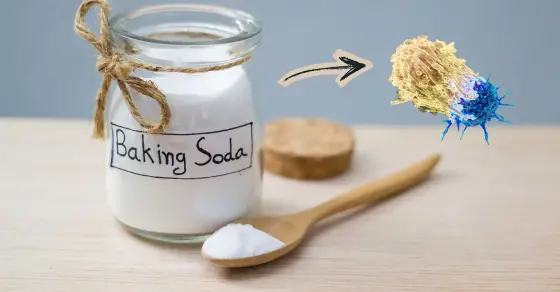
Baking soda (sodium bicarbonate) is a well-known alkaline buffering compound.
In laboratory and animal research, scientists have used sodium bicarbonate:
- To study changes in tumor microenvironment pH
- As a buffering agent to neutralize acidity around tumors
- To better understand how acidity affects cancer progression
Some animal studies have shown that altering tumor acidity can influence tumor behavior, including spread in certain models.
This has made sodium bicarbonate useful as a research tool — not a treatment.
What Research Has Observed
In controlled experiments (mostly in animals and laboratory settings), researchers have observed that:
- Tumors often thrive in acidic environments
- Neutralizing acidity around tumors can change cancer cell behavior
- Tumor acidity may interfere with immune responses
- Modifying pH can affect how cancer cells interact with surrounding tissue
These findings help scientists understand why tumor environments matter, not how to cure cancer at home.
What Baking Soda Research Does NOT Show
This is where many online articles go wrong.
Research does not show that:
- Baking soda cures cancer
- Baking soda treats cancer in humans
- Drinking baking soda safely alters tumor pH
- Baking soda replaces chemotherapy or medical care
The doses and delivery methods used in research cannot be safely replicated by drinking baking soda.
Large amounts of sodium bicarbonate can cause:
- Electrolyte imbalances
- Dangerous changes in blood chemistry
- Heart rhythm disturbances
- Metabolic alkalosis
This is why medical professionals warn against self-treatment.
Why “Alkalizing the Body” Is a Misleading Idea
A common myth is that cancer exists because the body is “too acidic.”
In reality:
- Blood pH is tightly regulated
- Food and supplements do not meaningfully change blood pH
- Attempts to force alkalinity can be dangerous
Tumor acidity is local, not systemic.
That’s why researchers focus on targeted approaches rather than whole-body alkalization.
Why Scientists Still Study Tumor Acidity
Even though baking soda isn’t a treatment, the research matters because it shows:
- Cancer cells are influenced by their environment
- Tumor behavior isn’t driven by genetics alone
- Metabolism and chemistry affect disease progression
This has opened new research areas, including:
- Targeted buffering strategies
- Drug delivery systems that alter tumor conditions
- Combination approaches that improve treatment effectiveness
All of this work happens in laboratories and clinical trials, not kitchens.
The Difference Between Research Tools and Treatments
A key point often missed online is the difference between:
- A research tool
- A medical therapy
Baking soda helps researchers explore questions about acidity.
That doesn’t mean it’s safe or effective as a treatment.
Many substances are useful in science but inappropriate or dangerous for self-use.
Why Misinformation Spreads So Easily
Cancer creates fear.
Fear creates urgency.
Urgency makes people vulnerable to simple explanations.
“Cancer is just acidity” feels reassuring because it implies:
- Control
- Simplicity
- A cheap solution
But cancer biology is complex.
Oversimplification doesn’t empower patients — it misleads them.
A Responsible Way to Think About Baking Soda and Cancer
Here’s the most accurate takeaway:
- Tumor acidity is a real area of cancer research
- Baking soda has been used to study acidity in controlled settings
- This research improves scientific understanding
- Baking soda is not an approved or recommended cancer treatment
Understanding science means respecting both its insights and its limits.
Supporting Health Without Risky Claims
People facing cancer often want to do something beyond standard care.
That desire is understandable.
Supportive strategies should focus on:
- Nutrition guidance from professionals
- Symptom management
- Mental and emotional support
- Evidence-based complementary care
- Open communication with healthcare teams
Replacing treatment with unproven methods is where harm occurs.
The Bottom Line
Baking soda and cancer are linked only through research on tumor acidity.
That research shows:
- Tumor environments matter
- Acidity can influence cancer behavior
- Sodium bicarbonate helps scientists study these effects
It does not show that baking soda reduces cancer in humans.
Curiosity about science is healthy.
Critical thinking protects health.
Understanding the difference between research insight and medical treatment keeps people safe — and informed.
Choosing Safe, Evidence-Aligned Solutions — Not Medical Shortcuts
One of the biggest lessons from baking soda and cancer research is this:
There’s a difference between scientific tools and personal health choices.
Baking soda has value in research and household use — but it doesn’t belong in medical self-treatment.
Where it does belong is in safe, non-toxic, everyday living, used for its intended purpose.
If you’re serious about avoiding misinformation and focusing on things that actually support long-term well-being, the smartest moves are often environmental — not experimental.
Here are two options that align with that philosophy.
🧼 Truly Free Home — Non-Toxic Cleaning Where Baking Soda Actually Belongs
Baking soda is often discussed online as a health shortcut — but in reality, it’s best used as a household cleaner, not a medical intervention.
That’s why we recommend Truly Free Home.
Truly Free offers:
- Essential oil–based cleaners
- Non-toxic formulas
- No harsh chemicals or synthetic fragrances
- Products designed for safe, everyday use
Instead of relying on aggressive chemicals — or misusing household ingredients for health claims — Truly Free provides purpose-built cleaning solutions that reduce chemical load in your home without unnecessary risk.
Cleaner environments matter.
But they should be achieved safely and appropriately.
👉 Explore Truly Free Home Cleaner & Detergent here:
🌬️ AirDoctor — Supporting a Cleaner Environment Without Medical Claims
Research into cancer increasingly shows that environment matters — from air quality to chemical exposure.
That doesn’t mean products treat disease.
It means reducing unnecessary environmental stressors is a reasonable, non-medical lifestyle choice.
AirDoctor focuses on:
- Removing airborne pollutants
- Reducing particulate matter
- Improving indoor air quality
- Creating a cleaner breathing environment at home
This aligns with what science actually supports:
you can improve your surroundings without making health claims or taking risks.
👉 Learn more about AirDoctor air purifiers here:
A Final Thought
The real danger isn’t curiosity.
It’s confusing research tools with personal treatment.
Science advances by studying complex systems carefully.
Personal health is best supported by safe choices, clean environments, and evidence-based care — not shortcuts or internet myths.
Use baking soda where it belongs.
Choose products designed for their purpose.
And let science guide understanding — not speculation.