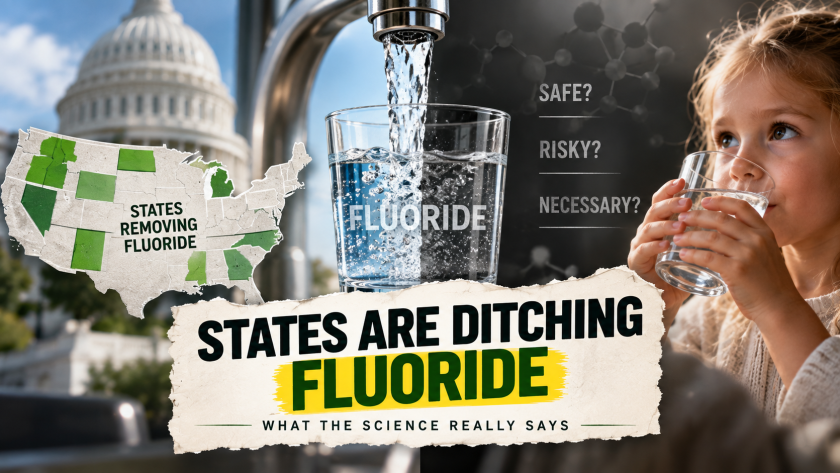
For nearly 80 years, fluoridated drinking water has been such a fixture of American public health policy that most people never thought twice about it. That’s changing fast. Utah became the first state in the country to ban water fluoridation outright in early 2025. Florida followed within weeks. As of the most recent count from the National Conference of State Legislatures, at least 21 states have introduced legislation this year to prohibit or roll back fluoridation, and the debate shows no signs of slowing down.
Watch the Full Investigation Before You Read On
Before getting into what the science actually shows, there’s a documentary that dives deeper into the political and scientific forces driving this shift than any single article can cover. Worth watching alongside this piece.
Click here to watch the MAHA film free
Click here to watch the MAHA film free
How We Got Here
This wave of legislation traces directly back to Health and Human Services Secretary Robert F. Kennedy Jr., who has called fluoride a “dangerous neurotoxin” and linked it publicly to arthritis, bone fractures, thyroid disease, and IQ loss. In April 2025, Kennedy announced he would direct the CDC to stop recommending water fluoridation nationally and said he was assembling a task force to review the science. EPA Administrator Lee Zeldin joined him at the announcement, saying fluoride review was “top of the list” for his agency.
Utah’s ban took effect May 7, 2025, prohibiting any city or water authority in the state from adding fluoride, regardless of what local communities individually decide. Florida became the second state shortly after. Bills modeled on Utah’s law have since been introduced in Tennessee, North Dakota, Montana, Arkansas, and many more.
This is genuinely one of the more consequential public health policy shifts happening in the country right now, and it deserves a straight answer, not a partisan one, about what the actual evidence shows.
A Brief History of Water Fluoridation in America
Understanding why this policy exists in the first place helps explain why the current fight is so charged. Grand Rapids, Michigan became the first U.S. city to fluoridate its public water supply in 1945, after researchers observed that communities with naturally higher fluoride levels in their groundwater had notably lower rates of tooth decay. Within 15 years, fluoridation spread to hundreds of American cities, driven by dramatic reductions in childhood cavities in the communities that adopted it.
By the 2020s, more than 60 percent of the U.S. population was connected to water systems with added fluoride, according to Kaiser Family Foundation data. For decades, it was treated as settled, uncontroversial public health policy, one of the rare interventions supported across party lines. What’s changed isn’t the water itself, it’s the political environment around it, driven substantially by Kennedy’s ascension to a position where his long-standing skepticism now carries the weight of federal health policy.
How the U.S. Compares to Other Countries
It’s also worth noting that the United States is something of an outlier globally, though perhaps not in the direction most coverage implies. Many European countries, including Germany, France, Sweden, and the Netherlands, don’t fluoridate water at all, often for logistical or regulatory reasons rather than safety concerns, and instead rely on fluoridated salt, fluoridated toothpaste, or topical treatments to achieve similar dental health outcomes. Countries like Ireland, Australia, and parts of Canada, on the other hand, maintain fluoridation programs similar to the U.S. and report comparable safety records.
This global variation is sometimes cited by both sides of the debate as evidence for their position, but the more accurate takeaway is that there are multiple viable public health strategies for preventing tooth decay, water fluoridation is simply the one the U.S. chose decades ago, and other approaches can work reasonably well too when implemented consistently.
What the Peer-Reviewed Science Actually Says
Here’s where a lot of coverage on both sides gets sloppy. The honest answer is that fluoride’s risk profile depends heavily on dose, and current U.S. water fluoridation levels are not the same as the exposure levels connected to documented harm.
The legitimate concern. In August 2024, the federal government’s National Toxicology Program released a report concluding, with “moderate confidence,” that there is an association between higher fluoride exposure and lower IQ in children. Critically, the exposure levels examined in that report were more than twice the level currently recommended for U.S. drinking water. The CDC’s current recommended fluoridation level is 0.7 milligrams per liter, set specifically to balance cavity prevention against any potential risk. The NTP report did not evaluate outcomes at that recommended level, and its authors were explicit that their findings shouldn’t be read as evidence of harm at typical U.S. fluoridation levels.
A federal judge separately ordered the EPA in September 2024 to further evaluate fluoride’s risk to children’s intellectual development, citing that same body of research, which has added momentum to the push for stricter oversight even among people who aren’t aligned with Kennedy’s broader positions.
What the science does not show. Kennedy’s public statements linking standard water fluoridation to arthritis, bone fractures, and thyroid disease go considerably further than the NTP’s findings support. Mainstream dental and medical organizations, including the American Dental Association and the CDC, maintain that water fluoridation at the recommended 0.7 mg/L level is both safe and effective, and note that the CDC has named it one of the ten great public health achievements of the 20th century specifically because of its role in reducing tooth decay.
Where that leaves an honest reader. The strongest, most defensible position based on current peer-reviewed evidence is this: fluoride at high concentrations, well above what’s added to U.S. water systems, is associated with measurable risk to children’s neurodevelopment. At the low concentrations actually used in community water fluoridation, the evidence for that same risk is weak to absent, while the evidence for dental benefit is well established. Reasonable people can still disagree about whether that risk profile justifies continuing a mandatory, population-wide intervention, that’s a legitimate values question about individual choice versus public health policy, not strictly a scientific one.
What Dentists Are Actually Worried About
The strongest pushback against fluoride bans hasn’t come from partisan messaging, it’s come directly from dentists and public health researchers concerned about a specific, well-documented consequence: the burden falls hardest on low-income families. Utah Governor Spencer Cox, who signed his state’s ban, has acknowledged the state saw no dramatic difference in dental outcomes between areas with and without fluoridated water, but national dental organizations point out that fluoridated water functions as a low-cost, passive protection specifically for people who can’t afford regular dental visits or fluoride treatments. When community water fluoridation ends, that protective effect doesn’t get replaced automatically, it simply disappears for households that relied on it most.
What This Means for Your Own Household, Regardless of Where Your State Lands
Whether your state keeps, adds, or removes fluoride from its water supply, you don’t have to wait on legislation to make your own decision about what’s in your glass. Here’s the practical part that most coverage of this story skips entirely: not all water filters treat fluoride the same way.
Filters that remove fluoride effectively:
- Reverse osmosis systems — considered the gold standard, capable of removing 85 to 95 percent of fluoride from water
- Activated alumina filters — specifically designed to target fluoride and commonly used in filter pitchers and under-sink systems marketed for fluoride reduction
- Deionization systems — effective but less commonly used in home settings due to cost
Filters that do NOT remove fluoride:
- Standard activated carbon filters — the type used in most basic pitcher filters and refrigerator water dispensers. These are excellent for chlorine, sediment, and many organic contaminants, but fluoride ions pass straight through unaffected.
- Boiling water — actually concentrates fluoride rather than removing it, since water evaporates but fluoride does not.
This distinction matters enormously, because a lot of families believe their standard pitcher filter is handling fluoride when it isn’t. If reducing fluoride intake specifically is a goal for your household, checking whether your current filtration system is actually rated for fluoride reduction is the single most useful first step.
Clearly Filtered offers filtration systems tested specifically for fluoride reduction alongside other contaminants, making it one of the more straightforward options for households wanting a filter that actually addresses this specific concern rather than assuming a standard carbon filter has it covered. Use code Welcome10 at checkout. This matters especially for households in states that still fluoridate but want the choice to opt out at the tap, without waiting on a legislative outcome that may take years to resolve one way or the other.
For households specifically interested in a dedicated fluoride-reduction pitcher or under-sink option using activated alumina media, Omica Organics offers water filtration products alongside its broader clean-living product line. Use code HealthyWildFree at checkout.
If You’re Choosing to Reduce Fluoride, Here’s What to Watch For Instead
If you do decide to reduce your household’s fluoride exposure, either because your state has ended fluoridation or because you’re filtering it out yourself, dentists recommend paying closer attention to a few other things to protect dental health in fluoride’s absence:
- Fluoride toothpaste still matters. Topical fluoride from toothpaste operates differently than ingested fluoride and remains one of the most well-supported cavity prevention tools available, independent of what’s in your water.
- Regular dental checkups become more important, not less, since your dentist can apply professional fluoride treatments or identify early decay before it becomes a bigger problem.
- Watch children’s sugar intake more closely, since one of fluoride’s primary protective roles is offsetting the cavity-causing effects of sugar and bacteria in the mouth.
- Ask your dentist about fluoride supplements or varnishes if your community water supply changes and you have young children at higher cavity risk.
- Consider your family’s specific risk profile. Children, people with dry mouth conditions, and those without regular access to dental care generally benefit most from fluoride exposure through some channel, whether that’s water, toothpaste, or professional treatment, while healthy adults with strong dental hygiene habits and regular checkups have more flexibility either way.
The Bottom Line
This is a genuinely more nuanced story than either “fluoride is a dangerous neurotoxin” or “fluoride is completely risk-free at every dose,” and your family deserves the nuanced version. The peer-reviewed evidence supports real caution at high fluoride exposure levels, but doesn’t currently support the strongest claims being made about typical U.S. water fluoridation levels. At the same time, the concern from dental and public health experts about low-income families losing a low-cost protective measure is well documented and deserves real weight in this debate too.
Whatever your state legislature ultimately decides, and whatever your own family’s values around this lead you to choose, understanding the difference between a filter that actually removes fluoride and one that doesn’t is the most practical, immediately useful thing you can act on today. This is a story that will likely keep evolving state by state over the next several years, and the most reliable protection isn’t waiting on any single legislature to settle the debate for you, it’s understanding what’s actually in your water and making an informed choice for your own household regardless of which way your state ultimately lands.