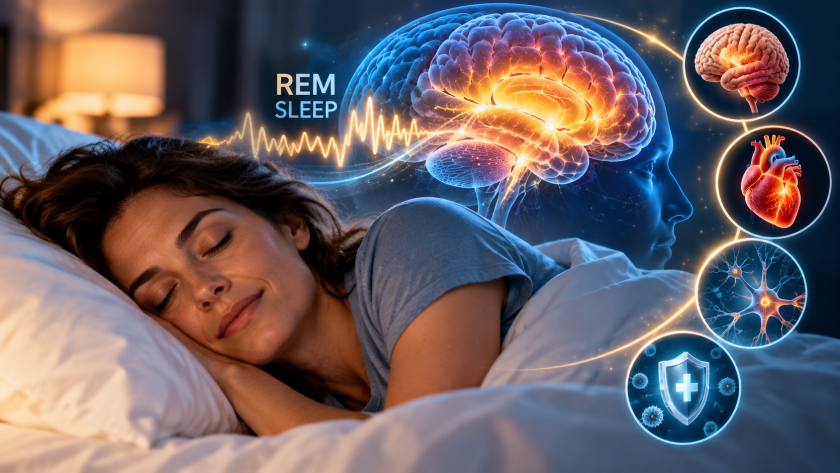
Sleep researchers have long known that how much you sleep matters. A massive new study published September 17, 2026 in PLOS Medicine suggests something more specific and, frankly, more useful: what stage of sleep you’re getting may matter just as much, if not more, for your long-term disease risk.
Led by Jingsong Luo of Peking University and Shengzhi Sun of Capital Medical University, the research tracked 95,559 adults from the UK Biobank for a median of nearly nine years, and the findings, spanning 83 distinct diseases linked to REM sleep alone, represent one of the most detailed pictures yet of exactly how sleep architecture connects to long-term health.
Watch the Full Investigation Before You Read On
Before getting into the full findings, there’s a documentary that explores the growing science connecting sleep quality to long-term disease prevention in more depth than a single article can cover. Worth watching alongside this piece.
Click here to watch the MAHA film free
Click here to watch the MAHA film free
What the Study Actually Did
This wasn’t a study relying on people’s memory of how well they slept. Researchers had all 95,559 participants wear wrist accelerometers continuously for seven consecutive days and nights, and used a deep-learning algorithm to estimate time spent in REM sleep, deep sleep, and light sleep, along with total sleep duration, time spent awake after initially falling asleep, and how much sleep patterns varied from night to night. That objective, device-measured approach is considerably more precise than the self-reported sleep surveys most earlier research relied on.
Participants, with an average age of 56.2 and 56.3 percent women, were then followed for a median of 8.9 years, with new disease diagnoses tracked through health records covering nearly 1,100 different conditions.
What the Researchers Found
The results, across six different sleep measures, were extensive. Higher amounts of REM sleep were associated with lower risk for 83 separate diseases. Greater deep sleep was associated with lower risk for 7 conditions, including type 2 diabetes and major depressive disorder. On the other end, greater sleep irregularity was linked to elevated risk for 3 conditions, and more time spent awake after initially falling asleep was linked to elevated risk for 6 conditions, including psychoactive substance dependence and alcohol abuse.
The diseases most strongly associated with higher REM sleep spanned a striking range: Parkinson’s disease, multiple sclerosis, dementia, Alzheimer’s disease, heart failure, atrial fibrillation, and hypotension all showed some of the strongest protective associations. Total sleep duration mattered too, with the lowest overall disease risk observed among people sleeping 6 to 8 hours per night, while sleeping less than 5 hours per night was linked to elevated risk across 37 separate disease outcomes.
An Important Caveat From the Researchers Themselves
It’s genuinely important to represent this research accurately, and the study’s own authors were direct about its limits. This is an observational study, meaning it can identify strong, consistent statistical associations between sleep patterns and disease risk, but it cannot, on its own, prove that changing your REM sleep directly causes a change in your disease risk. The researchers explicitly noted this limitation themselves, stating plainly that as an observational study, the research cannot establish that sleep patterns directly cause changes in disease risk.
That said, the researchers also pointed to a specific, meaningful takeaway they felt the data did support: that getting 6 to 8 hours of sleep functions as a real health safeguard for middle-aged and older adults, likely because that sleep duration range is associated with a more favorable overall distribution of sleep stages, including more time in REM.
Why This Research Carries Extra Weight
A few factors make this particular study stand out from typical sleep research. First, its sheer scale, tracking more than 95,000 people, gave researchers enough statistical power to detect associations across nearly 1,100 different disease outcomes, something far smaller studies simply can’t do reliably. Second, the objective, device-measured sleep data removes a major source of error present in most prior sleep research, which has relied heavily on people’s own memory and self-reporting of how well and how long they slept, a notoriously unreliable measure. Third, the nearly nine-year follow-up period allowed researchers to capture genuinely long-term disease outcomes, rather than short-term associations that might not hold up over time.
The study also arrives amid growing public health attention to sleep more broadly. The research specifically cites the 2026 China Sleep Health White Paper, which found that the average surveyed adult sleeps just 6.97 hours per night, with 23 percent sleeping less than 6 hours, and only 26 percent maintaining a consistent sleep schedule. While that data reflects a different population than the UK-based study cohort, the broader pattern, widespread sleep insufficiency and irregularity, reflects concerns raised by sleep researchers across many countries, including the United States, where similar patterns of insufficient and irregular sleep have been well documented in national health survey data.
Why REM Sleep Specifically Might Matter So Much
REM, or rapid eye movement, sleep is the stage most associated with vivid dreaming, and it plays a documented role in memory consolidation, emotional processing, and brain plasticity. Researchers have proposed several possible mechanisms for why REM sleep specifically might connect to such a wide range of disease outcomes: it’s a period of heightened brain activity that appears important for clearing metabolic waste products from the brain, regulating stress hormones, and supporting the neural connections tied to memory and mood regulation, all processes plausibly connected to conditions ranging from dementia to depression to cardiovascular health.
It’s worth noting that REM sleep naturally makes up a smaller proportion of total sleep as people age, which is part of why researchers are particularly interested in what factors help preserve it, and why this study’s findings carry real relevance for older adults specifically, the population already facing elevated risk for many of the 83 conditions identified.
What’s Known to Reduce REM Sleep
Based on well-established sleep science, separate from this specific study, several common habits are known to reduce REM sleep specifically:
Alcohol is one of the most well-documented REM suppressors. While alcohol can make you fall asleep faster, it significantly reduces REM sleep during the first half of the night, and disrupted sleep architecture, including REM rebound and fragmented sleep, often follows later in the night as the alcohol is metabolized.
Many sleep medications, particularly benzodiazepines and some older sleep aids, are known to suppress REM sleep as part of how they work, even though they may increase total sleep time or light sleep.
Late-night screen use exposes you to blue light that can suppress melatonin production and delay sleep onset, indirectly reducing the total REM sleep obtained during a shortened or delayed sleep window.
Irregular sleep schedules disrupt the body’s circadian rhythm, which governs the natural progression through sleep stages, including the timing and duration of REM cycles, which tend to lengthen later in the night.
Chronic stress and elevated cortisol have also been associated with reduced REM sleep in various studies, adding another reason stress management plays a role in sleep architecture, not just sleep quantity.
What May Help Support Healthy REM Sleep
A few evidence-informed habits and considerations, worth being honest about the strength of evidence behind each:
Consistent sleep and wake times have strong, well-established support in sleep science for supporting healthy sleep architecture overall, including REM sleep, since REM cycles are tied closely to circadian rhythm regularity.
Avoiding alcohol close to bedtime is well-supported given alcohol’s documented REM-suppressing effect; many sleep specialists suggest avoiding alcohol within at least a few hours of bed if REM sleep quality is a concern.
Magnesium glycinate is commonly used to support relaxation and sleep quality generally. It’s worth being precise here: the evidence specifically tying magnesium supplementation to increased REM sleep, as opposed to general sleep quality and relaxation, is more limited than for some of the other factors discussed here, though magnesium deficiency has been associated with disrupted sleep patterns in some research.
Ashwagandha has research support for reducing stress and cortisol levels and modestly improving overall sleep quality in several clinical trials, which may indirectly support healthier sleep architecture given cortisol’s documented relationship to sleep disruption, though direct evidence of ashwagandha specifically increasing REM sleep duration is still an emerging area of research rather than firmly established.
Keeping bedrooms cool, dark, and screen-free in the hour before bed supports the broader conditions known to protect healthy sleep architecture, including REM sleep, based on well-established sleep hygiene research.
What This Means for You
Given both the scale of this study and its honest limitations, here’s a reasonable way to apply it to your own life:
- Prioritize 6 to 8 hours of sleep consistently, since this range showed the lowest overall disease risk in the study and reflects one of its most directly actionable findings.
- Keep your sleep schedule consistent, even on weekends, since irregularity was independently linked to elevated disease risk in this research.
- Limit alcohol, especially close to bedtime, given its well-documented effect on REM sleep specifically.
- Talk to your doctor if you rely on sleep medication regularly, particularly if you’re concerned about REM sleep specifically, since some common sleep aids are known to suppress it.
- Consider a sleep tracker if you’re curious about your own sleep architecture, understanding that consumer devices vary in accuracy compared to the research-grade accelerometers used in this study.
- Don’t panic over a single bad night. This research reflects patterns measured over a full week and disease outcomes tracked over nine years, not the impact of any single night’s sleep.
Supporting Healthy Sleep
For those looking to support overall sleep quality alongside the habits discussed above, a few options worth considering:
Bioptimizers Magnesium offers a full-spectrum magnesium formula, including magnesium glycinate, designed to support relaxation and healthy sleep. Use code Healthywildfree at checkout.
Hatch Restore offers a sunrise alarm and sleep routine device designed to support consistent sleep and wake times through gradual light cues, directly supporting the circadian regularity this research points to as beneficial.
To be clear, neither of these products has been directly studied for its effect on REM sleep specifically in research at the scale of the study discussed in this article. They’re reasonable complements to the well-established sleep hygiene habits, consistent timing, limiting alcohol, and a dark, cool sleep environment, that have the strongest evidence behind them.
The Bottom Line
This is one of the largest, most rigorously measured studies yet connecting specific sleep stages to long-term disease risk, and the sheer breadth of the REM sleep findings, 83 distinct diseases, spanning neurological, cardiovascular, and metabolic conditions, is genuinely remarkable. It’s an observational study, not proof of direct causation, and the researchers themselves are careful to say so. But the practical takeaway holds up regardless: consistent, adequate sleep, in the 6 to 8 hour range, appears to be one of the more powerful, low-cost levers available for supporting long-term health, and protecting your REM sleep specifically, by limiting alcohol, keeping a consistent schedule, and managing stress, is a reasonable, evidence-aligned goal worth prioritizing, particularly given how many of the 83 conditions identified, from dementia to heart failure, are exactly the kind of long-term, life-altering diagnoses most worth taking preventive steps against today.