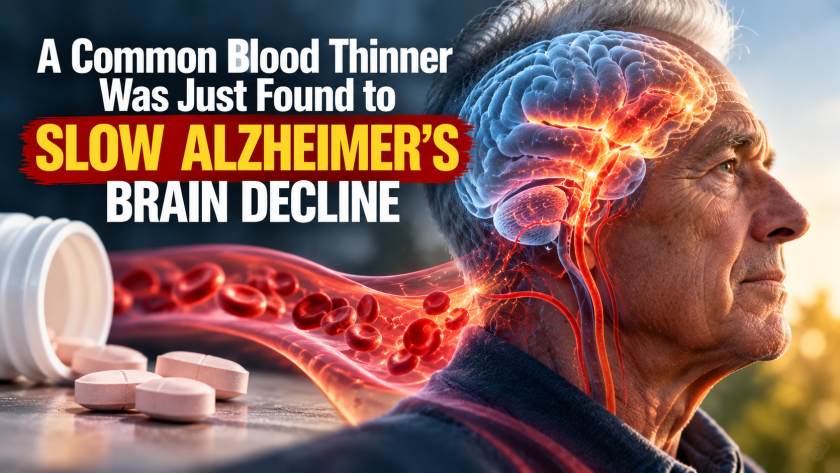
A large new study out of Sweden’s Karolinska Institutet has found that people with both atrial fibrillation and Alzheimer’s disease experienced meaningfully slower cognitive decline when treated with a newer class of blood thinners, compared to those on older medication or no blood thinner at all. Published in the European Heart Journal on August 12, 2026, and widely picked up by health outlets throughout September, the study points toward something genuinely interesting: brain blood flow itself may play a bigger role in Alzheimer’s progression than has typically been emphasized in mainstream treatment conversations.
Here’s what the study actually found, why researchers think it happened, and what the evidence honestly supports if you’re interested in supporting healthy brain blood flow, alongside, not instead of, appropriate medical care.
Watch the Full Investigation Before You Read On
Before getting into the study details, there’s a documentary that explores emerging connections between circulation, brain health, and cognitive decline in more depth than a single article can cover. Worth watching alongside this piece.
Click here to watch the MAHA film free
Click here to watch the MAHA film free
What the Study Actually Found
Researchers analyzed data from SveDem, the Swedish Register for Cognitive Disorders/Dementia, a national quality registry, covering 7,308 people diagnosed with both atrial fibrillation and Alzheimer’s disease. Atrial fibrillation, commonly called AFib, is an irregular heart rhythm common in older adults that raises stroke risk and is frequently treated with blood-thinning medication to prevent dangerous clots.
The researchers, led by Nanbo Zhu, sorted participants into three matched groups: those treated with newer anticoagulants known as NOACs (non-vitamin K oral anticoagulants, which include commonly prescribed medications like apixaban and rivaroxaban), those treated with the older blood thinner warfarin, and those who received no anticoagulant medication at all. Cognitive function was tracked over time using the Mini-Mental State Examination, a standardized memory and thinking assessment widely used in dementia research.
The result: people treated with NOACs showed significantly slower cognitive decline than those on warfarin or no anticoagulant at all. The effect was described as modest year to year but potentially meaningful when it accumulates over time. NOAC treatment was also associated with lower risk of death, stroke, blood clots, and fractures compared to no anticoagulant use. Warfarin was similarly associated with lower risk of death, stroke, and blood clots compared to no treatment, but carried a higher risk of major bleeding than the newer NOACs.
Why AFib and Alzheimer’s So Often Occur Together
Understanding this study requires understanding why researchers were looking at this specific patient population in the first place. Atrial fibrillation is common in older adults generally, and it’s especially common among people living with Alzheimer’s disease, a pattern researchers have increasingly studied as more than coincidental. Population research has found that atrial fibrillation itself is associated with an increased risk of cognitive impairment and dementia, independent of stroke, suggesting the irregular heart rhythm may contribute to cognitive decline through ongoing, cumulative circulatory effects on the brain rather than only through the risk of a single major stroke event.
This growing body of research has shifted how some clinicians think about AFib treatment more broadly. Historically, anticoagulant therapy in AFib patients was primarily framed around preventing a major, obvious stroke. This newer research suggests the value of adequate anticoagulation may extend further, into protecting against the kind of cumulative, less visible vascular damage that can accelerate cognitive decline over months and years, a meaningfully different way of thinking about why consistent, appropriate treatment matters for this patient population.
Why Researchers Think This Happened
Study co-senior author Maria Eriksdotter, a professor at Karolinska Institutet and senior consultant in geriatric medicine, explained the proposed mechanism directly: there are reasons to believe the treatment could have a positive effect on cognition by improving blood flow and reducing small-scale damage in the brain.
This connects to a well-established but somewhat underappreciated piece of AFib pathology. When the heart’s upper chambers quiver irregularly instead of beating in a coordinated rhythm, blood can pool and form small clots, some of which travel to the brain and cause what researchers call “silent strokes,” tiny areas of blood flow disruption too small to produce obvious stroke symptoms, but capable of causing cumulative damage over time. Growing evidence has connected this kind of silent, repeated microvascular injury to accelerated cognitive decline, independent of Alzheimer’s disease’s own separate underlying pathology. Anticoagulant medication reduces the clot formation responsible for this ongoing damage, and NOACs appear to do this more effectively, and with a better safety profile, than older medications like warfarin.
Important Limitations Worth Knowing
To be fair to the research itself, the study’s authors were upfront about real limitations. This is an observational study, meaning it can show a strong association but cannot establish cause and effect with the same certainty as a randomized controlled trial. Some factors influencing both which medication a patient received and their subsequent health outcomes couldn’t be fully accounted for, and some patients likely switched between medications during the study period, which can complicate this kind of long-term analysis. The researchers themselves frame this as an important, meaningful finding worth further study, not a definitively settled question.
The Natural Blood-Flow Connection, and Where the Evidence Actually Stands
This research adds real scientific weight to something that’s long been discussed in natural health circles: that brain function depends heavily on clean, adequate blood flow, and that supporting circulation may matter for cognitive health beyond simply preventing a major stroke. That’s a legitimate, evidence-supported idea. But it’s important to be precise about what does and doesn’t have solid evidence behind it, especially since this specific study was about prescription anticoagulants in a very particular patient population, people with both diagnosed AFib and Alzheimer’s, not a general population taking supplements.
Omega-3 fatty acids have a genuinely well-established evidence base supporting cardiovascular health and healthy circulation more broadly, including some research connecting adequate omega-3 intake to cognitive health outcomes over time. This is one of the more solidly supported natural approaches to supporting blood flow and brain health.
Nattokinase and serrapeptase are enzymes that have drawn interest for their fibrinolytic properties, meaning they may help break down fibrin, a protein involved in clot formation. They’ve been used in some traditional and natural health contexts for general circulatory support. Here’s where real caution is essential: these compounds are not proven substitutes for prescribed anticoagulant medication in anyone with diagnosed atrial fibrillation. Because they can affect clotting, taking them alongside a prescribed blood thinner, or using them in place of one, can meaningfully increase bleeding risk or leave someone with AFib inadequately protected against stroke, since there’s no robust clinical evidence that these supplements provide the same protective effect against AFib-related stroke that NOACs demonstrated in this study. If you have diagnosed atrial fibrillation, talk to your cardiologist before adding either of these supplements to your routine, particularly if you’re already on prescribed anticoagulant medication.
What This Means for You
If you or a family member has atrial fibrillation, Alzheimer’s disease, or both, this research is worth bringing directly to your doctor’s attention, particularly if warfarin or no anticoagulant is your current treatment approach:
- Ask your doctor specifically about NOACs versus warfarin if you’re currently on warfarin or no anticoagulant and have AFib, given both the cognitive findings here and the broader safety profile differences identified in the study.
- Don’t stop or change any prescribed blood thinner without medical guidance, regardless of what you read here, since abruptly stopping anticoagulant medication in someone with AFib carries serious stroke risk.
- Discuss omega-3 intake with your doctor as a complementary approach to supporting cardiovascular and brain health, since it has a reasonably solid evidence base and is generally considered safe for most people, though it can still interact with blood thinners at high doses.
- Be cautious with nattokinase and serrapeptase specifically if you’re on any blood-thinning medication, prescription or otherwise, and always loop in your doctor before combining them.
- Ask about silent stroke risk specifically if you have AFib, since this is a less commonly discussed but clinically significant aspect of the condition that this research highlights.
- Keep up with regular cognitive screening if you have both AFib and a dementia diagnosis, since tools like the MMSE used in this study are the same kind of standardized assessments your own doctor can use to track changes over time and inform treatment decisions.
Supporting Healthy Circulation and Brain Health
For those looking to support overall cardiovascular and brain blood flow through diet and supplementation, alongside appropriate medical care rather than in place of it, a few options worth knowing about:
Cardio Miracle offers a nitric-oxide based formula designed to support healthy blood flow and circulation. Use code healthywildfree at checkout.
Qualia offers formulas designed to support overall cognitive function and brain health as part of a daily routine. Use code HEALTHYWILDANDFREE at checkout.
To be direct about the limits here: neither of these products has been studied for AFib-related stroke prevention or for slowing Alzheimer’s progression the way NOAC medications have in this research. If you have diagnosed atrial fibrillation, appropriate prescribed anticoagulant therapy, guided by your doctor, remains the evidence-based standard of care, and any supplement should be discussed with your doctor as a complement, never a replacement.
The Bottom Line
This research adds genuine, well-designed scientific weight to the idea that brain blood flow matters for cognitive health beyond simply preventing a major stroke, a connection natural health practitioners have emphasized for years. The specific finding here, that newer blood thinners slowed cognitive decline in people with both AFib and Alzheimer’s more than older medication or no treatment, is a real, meaningful result from a large, well-designed study. What it doesn’t show is that natural supplements can replicate this specific protective effect in people with diagnosed AFib, and anyone in that situation should treat this as a reason to have a more informed conversation with their doctor, not a reason to consider supplements as a substitute for prescribed care. As research into the brain blood flow connection continues to develop, expect this to remain an active area of study, one that may eventually offer more nuanced, personalized guidance on how anticoagulant choice, and potentially complementary lifestyle and nutritional factors, interact to support long-term cognitive health in people managing both of these common conditions.