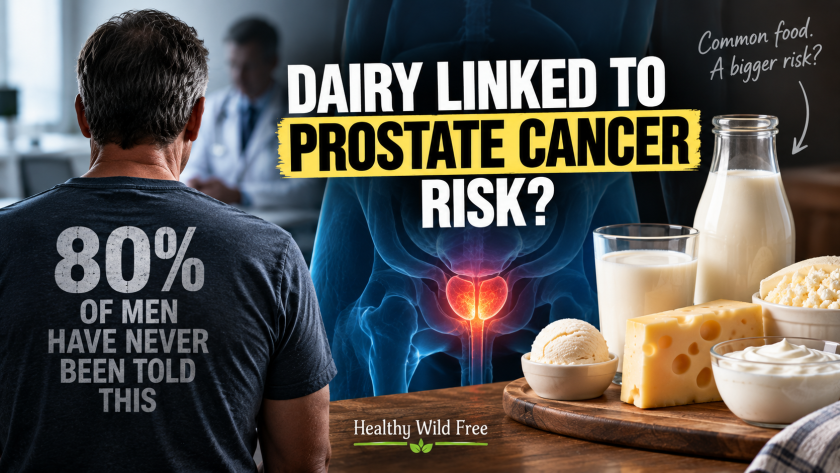
Prostate cancer is the most commonly diagnosed cancer among American men, with the American Cancer Society projecting 333,830 new cases and 36,320 deaths in the United States in 2026 alone. Given how common it is, you’d expect most men to know the major, research-backed risk factors tied to their own daily habits. A new national survey suggests most don’t, at least not when it comes to one specific factor: dairy.
Released September 13, 2026, during Prostate Cancer Awareness Month, the survey found that only 20 percent of U.S. men are aware that research has linked dairy consumption to an increased risk of prostate cancer. Just as strikingly, only 1 in 5 said a healthcare professional had ever discussed nutrition’s role in prostate cancer risk with them at all.
A Quick Primer on Prostate Cancer
Before getting into the dairy research specifically, it helps to understand the broader picture. Prostate cancer is the most commonly diagnosed cancer among men in the United States, excluding skin cancers, and the second leading cause of cancer death in men, according to the American Cancer Society. It develops in the prostate gland, a small gland below the bladder that produces seminal fluid, and it varies enormously in how it behaves. Some prostate cancers grow so slowly they may never cause symptoms or require treatment in a man’s lifetime, while others are aggressive and can spread beyond the prostate if not caught and treated early.
Because of that wide variation, early detection through appropriate screening, typically involving PSA blood tests and sometimes digital rectal exams, remains one of the most impactful factors in outcomes. Known risk factors include age, since risk rises significantly after 50, family history and genetics, and race, with Black men facing notably higher incidence and mortality rates than other groups in the U.S. Diet has increasingly become part of this conversation as more research has accumulated, but it sits alongside these other, non-modifiable risk factors rather than replacing the importance of regular screening.
Watch the Full Investigation Before You Read On
Before getting into what the research actually shows, there’s a documentary that explores the broader gap between nutrition science and what actually gets communicated in routine medical care. Worth watching alongside this piece.
Click here to watch the MAHA film free
Click here to watch the MAHA film free
What the Survey Actually Found
The survey was conducted by Morning Consult, a respected independent polling firm, on behalf of the Physicians Committee for Responsible Medicine, a nonprofit founded in 1985 that promotes preventive medicine and plant-based nutrition research. It’s worth naming that affiliation upfront, since PCRM has a clearly stated position favoring plant-based diets, which doesn’t make its survey data inaccurate, Morning Consult conducted the actual polling independently, but it’s relevant context for understanding who commissioned the research and why.
The topline findings: only 20 percent of the 1,102 U.S. men surveyed knew that research has associated dairy consumption with increased prostate cancer risk. After being told about the research, 66 percent said they would consider avoiding dairy products going forward. And only 20 percent said a healthcare professional had ever discussed the relationship between nutrition and prostate cancer risk with them at all, regardless of dairy specifically.
Noah Praamsma, a registered dietitian with PCRM, argued the findings point to a real gap in medical education, saying physicians and other healthcare professionals need more training on both the risks associated with dairy products and the potential benefits of a plant-based diet specifically for prostate cancer.
What the Underlying Research Actually Shows
Here’s the part that matters most: what does the science say, independent of who’s citing it? A meta-analysis combining 32 separate studies found evidence of an elevated prostate cancer risk among men with higher dairy consumption. One study cited in that body of research found that men who consumed at least one serving of skim or low-fat milk daily had a 19 percent higher risk of prostate cancer compared to men with lower intake. Separate research examining dairy and prostate cancer mortality specifically, a meta-analysis of 11 studies covering more than 700,000 participants, found mortality rates were meaningfully higher, in some analyses up to 50 percent higher, among men with the highest whole milk intake compared to those with the lowest.
It’s important to be precise about what this kind of research can and can’t establish. These are observational, association-based studies, not randomized controlled trials. They show a statistical relationship between higher dairy intake and higher prostate cancer risk across large populations, not proof that dairy directly causes prostate cancer in any individual case. Multiple outlets covering this survey’s release specifically flagged this distinction, and it’s an important one: association is real and worth taking seriously, but it’s a different, weaker claim than direct causation.
Why Might Dairy Be Connected to Prostate Cancer Risk?
Researchers have proposed a few possible biological mechanisms, though none is fully settled. Dairy consumption raises blood levels of insulin-like growth factor 1 (IGF-1), a hormone that’s been linked in other research to cancer cell growth. Milk, particularly from pregnant cows, contains naturally occurring hormones, including estrogen and other reproductive hormones, that some researchers hypothesize could play a role. Calcium intake at very high levels has also been examined as a possible factor, since calcium can suppress the body’s active form of vitamin D, which some research suggests may have a protective effect against certain cancers.
None of these mechanisms is considered definitively proven as the explanation, and research in this area is ongoing. What’s more consistently supported across the research is the population-level association itself, even as the precise biological explanation remains an active area of study.
Why So Few Men Hear About This From Their Doctor
It’s worth resisting the temptation to frame this gap as a deliberate cover-up, since the more likely, more mundane explanation fits the evidence better. Routine medical appointments, particularly primary care visits, are often short and packed with competing priorities, screenings, medication management, more urgent symptoms, leaving limited time for detailed nutrition counseling on any single topic. Dietary risk factors for cancer generally receive less consistent attention in standard medical training and practice compared to factors like smoking or family history, not because doctors are hiding information, but because nutrition science translates into clinical guidance more slowly and less uniformly than more directly actionable risk factors do.
That said, the practical result for patients is the same regardless of the reason: most men simply aren’t getting this information as part of their regular care, and if you want it, the survey data suggests you may need to raise it yourself rather than wait for it to come up.
What Research Suggests About Plant-Based Alternatives
On the other side of this research, several studies have examined plant-based eating patterns specifically in relation to prostate cancer outcomes. Research, including findings from the long-running Adventist Health Study-2, has associated plant-based and vegan dietary patterns with lower rates of prostate cancer diagnosis. Among men already diagnosed with prostate cancer, some research has also associated plant-forward eating patterns with lower rates of disease progression and recurrence.
As with the dairy research, these are largely observational findings rather than randomized controlled trials proving direct causation, but the consistency of the association across multiple studies has been enough to prompt organizations like PCRM to actively promote dietary counseling as part of prostate cancer risk reduction and management.
What This Means for You
If you’re a man, especially one with a family history of prostate cancer or other risk factors, this is worth raising directly with your own doctor rather than assuming it will come up on its own. A few practical steps:
- Ask your doctor directly about nutrition and prostate cancer risk at your next checkup, since the survey data suggests this conversation often doesn’t happen unless a patient initiates it.
- Know your other risk factors. Age, family history, race, and genetics all play a significant role in prostate cancer risk, and diet is one factor among several, not the whole picture.
- Consider gradually reducing high-fat dairy intake if you’re concerned, favoring lower-fat dairy or plant-based alternatives, while discussing any significant dietary changes with your doctor, particularly if you have other health conditions.
- Stay current on prostate cancer screening recommendations appropriate for your age and risk profile, since early detection remains one of the most impactful factors in prostate cancer outcomes regardless of diet.
- Don’t treat this as a reason to panic about occasional dairy consumption, since the research reflects population-level patterns over years of intake, not a single glass of milk or serving of cheese.
- Bring a specific question rather than a vague one. Asking “does my diet, particularly dairy intake, affect my prostate cancer risk” is more likely to prompt a substantive answer than a general “any health tips” question during a short appointment.
Plant-Based Options Worth Considering
For men looking to explore reducing dairy intake based on this research, a few well-regarded plant-based alternatives worth knowing about:
Boku Superfoods offers plant-based protein and superfood products designed as whole-food alternatives for those looking to shift away from dairy-based protein sources. Use code HealthyWildFree at checkout.
For general nutritional support during a dietary transition like this, HealthyCell offers a broad-spectrum daily multivitamin that can help ensure nutrients commonly associated with dairy, including calcium and vitamin D, are still adequately covered if you reduce dairy intake. Use code healthywildfree at checkout.
To be clear, neither of these products treats or prevents prostate cancer, and reducing dairy intake is not a guaranteed protective measure on its own. This is dietary information to discuss with your doctor, not a substitute for regular screening or medical care.
The Bottom Line
Most men have never had a conversation with their doctor about nutrition’s potential role in prostate cancer risk, and most don’t know that a meaningful body of research has associated higher dairy consumption with increased risk. That gap is real and well-documented by this survey. Whether it reflects a systemic failure in medical education, as PCRM argues, or simply the practical limits of short appointment times and evolving nutrition science, the takeaway for you is the same either way: this is a conversation worth having with your own doctor directly, armed with real questions, rather than waiting for it to come up on its own. Given that prostate cancer affects roughly 1 in 8 men over their lifetime, and given that diet is one of the few risk factors actually within your control, closing this awareness gap for yourself, regardless of why it exists in the first place, is a genuinely worthwhile use of five minutes at your next appointment.