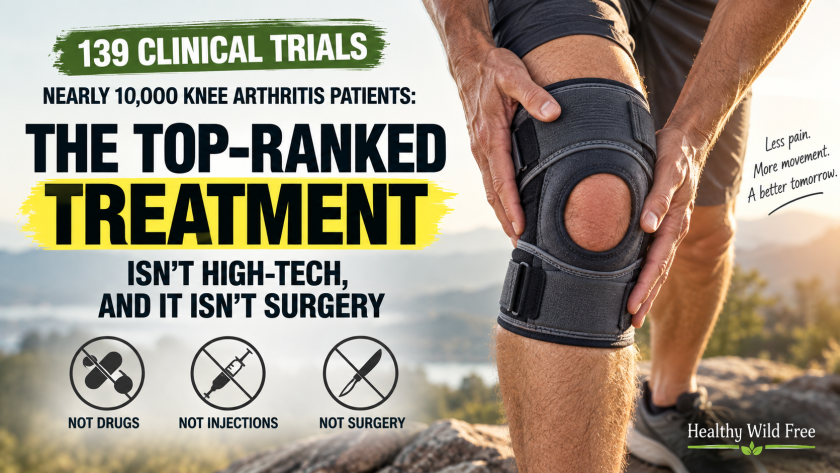
Over 32 million Americans live with knee osteoarthritis, a condition that wears down the cartilage cushioning the knee joint, leading to pain, stiffness, and reduced mobility that can make everyday movement genuinely difficult. When it comes to treatment, patients are often offered a familiar menu: pain medication, physical therapy referrals, injections, and eventually, for many, a conversation about knee replacement surgery, a procedure that typically costs tens of thousands of dollars.
A major new analysis published in PLOS One in 2025 and widely resurfacing in health coverage this month took a different approach entirely. Researchers combined data from 139 randomized clinical trials involving 9,644 patients to directly compare 12 non-drug treatment approaches against each other. The result: the simplest, least expensive option in the entire comparison came out on top.
Understanding Knee Osteoarthritis
Before getting into the treatment rankings, it helps to understand what’s actually happening inside an osteoarthritic knee. The knee joint is cushioned by cartilage, a smooth, flexible tissue that allows the bones to glide against each other without friction. Osteoarthritis develops as this cartilage gradually breaks down over time, whether from age, prior injury, repetitive stress, excess body weight, or genetic factors, leading to bone-on-bone contact, inflammation, and the pain and stiffness that define the condition.
Unlike some forms of arthritis, knee osteoarthritis isn’t primarily an autoimmune or inflammatory disease in its origin, it’s largely mechanical, driven by wear and tear on the joint structure itself. That distinction matters clinically, because it’s part of why mechanical interventions, like bracing, which directly redistributes load on the joint, and exercise, which strengthens the muscles that help support and stabilize it, tend to show up as genuinely effective in the research, rather than being purely a placebo effect of “doing something” about the pain.
Watch the Full Investigation Before You Read On
Before getting into the full ranking, there’s a documentary that explores broader questions about evidence-based versus profit-driven approaches in modern healthcare. Worth watching alongside this piece.
Click here to watch the MAHA film free
Click here to watch the MAHA film free
What This Study Actually Did
Researchers led by Yuan Luo at the First People’s Hospital of Neijiang in China conducted what’s called a network meta-analysis, a statistical method that allows researchers to compare multiple treatments against each other simultaneously, even when the original individual studies only compared one or two treatments directly against a placebo. This approach lets researchers rank a full field of options against a common baseline, something a single traditional study can’t do.
The team searched five major medical databases and ultimately included 139 randomized controlled trials, the gold standard for clinical evidence, covering 9,644 patients with knee osteoarthritis. The 12 treatments compared were: low-level laser therapy, high-intensity laser therapy, transcutaneous electrical nerve stimulation (TENS), interferential current therapy, short-wave diathermy, ultrasound, lateral wedged insoles, knee braces, exercise therapy, hydrotherapy (water-based therapy), kinesiology taping, and extracorporeal shock wave therapy. It’s worth being precise about scope here: this analysis compared these 12 non-drug, non-surgical approaches against each other and against placebo. It did not directly compare any of them against knee replacement surgery or prescription medications within the study itself.
The Full Ranking, From Best to Worst
Across the study’s key outcome measures, pain, physical function, and joint stiffness, researchers found a consistent pattern. Here’s how the 12 treatments ranked, from most to least effective:
- Knee brace — ranked highest across pain, function, and stiffness measures
- Hydrotherapy (water-based therapy) — particularly strong for pain relief
- Exercise therapy — consistently improved both pain and physical function
- Extracorporeal shock wave therapy (ESWT)
- High-intensity laser therapy (HILT)
- Low-level laser therapy (LLLT)
- Transcutaneous electrical nerve stimulation (TENS)
- Interferential current therapy
- Kinesiology taping
- Short-wave diathermy
- Ultrasound — one of the consistently weakest performers across measures
- Lateral wedged insoles — ranked lowest overall
The study’s authors were direct about the practical implication of these findings, noting in their conclusion that physical therapy approaches offer promising effects for knee osteoarthritis without the gastrointestinal or cardiovascular risks associated with common anti-inflammatory pain medications.
Why a Simple Brace Outperformed High-Tech Options
It might seem counterintuitive that a basic knee brace outperformed laser therapy, ultrasound, and electrical stimulation devices, technologies that sound more sophisticated and are often marketed as more advanced. But the mechanism behind bracing’s effectiveness is fairly straightforward. A well-fitted knee brace provides mechanical support and stability, redistributing weight-bearing forces across the joint and reducing strain on the specific areas of cartilage that have worn down the most. For many patients, especially those with osteoarthritis concentrated on one side of the knee, this direct mechanical support addresses the problem more directly than modalities like ultrasound or electrical stimulation, which work through less direct physiological pathways.
Hydrotherapy’s strong showing follows similar logic: water’s buoyancy reduces the load on the joint during movement, allowing patients to exercise and improve mobility with substantially less pain than land-based movement alone. And plain exercise therapy’s consistent performance reinforces something physical therapists have emphasized for years, that strengthening the muscles surrounding the knee joint provides meaningful, lasting support.
An Important Caveat From the Researchers Themselves
To be fair to the full picture, the study’s own authors flagged real limitations in their findings, and a responsible summary should include them. They noted that differences in study design, relatively small sample sizes in some of the included trials, and variability in treatment duration across the 139 studies may limit the precision of the exact rankings. This doesn’t undermine the overall pattern, simple, low-tech interventions performing at least as well as, and often better than, more elaborate ones, but it does mean the precise order beyond the top few positions should be read as a reasonable estimate based on available evidence, not an exact, unshakeable hierarchy.
Where Surgery Fits Into This Picture
It’s worth being direct about something this study didn’t test but that its findings still bear on: knee replacement surgery remains, for many patients with advanced osteoarthritis, a legitimate and sometimes necessary treatment, particularly once cartilage damage has progressed to the point where conservative measures no longer provide adequate relief. This research doesn’t argue otherwise, and it shouldn’t be read as evidence that surgery is unnecessary or that patients with severe osteoarthritis should avoid it.
What this research does support is a more evidence-based starting point: for patients with mild to moderate knee osteoarthritis, cheap, low-risk, accessible interventions like bracing, water-based exercise, and general strength training have real clinical evidence behind them and involve none of the risks, cost, or recovery time associated with surgery. Given that knee replacement surgery typically costs tens of thousands of dollars and carries the inherent risks of any major surgical procedure, starting with what the strongest available evidence actually supports, before escalating to more invasive options, is a reasonable, evidence-aligned approach worth discussing with your own doctor.
What About Supplements Like Turmeric, Boswellia, and Collagen?
It’s important to be clear that this specific 139-trial analysis did not evaluate dietary supplements, since its scope was limited to physical therapy modalities. That said, separate research has examined several commonly used supplements for osteoarthritis specifically, and it’s worth summarizing that evidence honestly rather than overstating it.
Turmeric/curcumin has some clinical trial support for modestly reducing osteoarthritis pain and inflammation, though study quality and dosing vary considerably across the research. Boswellia serrata has similarly shown modest anti-inflammatory effects in some smaller trials, though the evidence base is less extensive than for turmeric. Collagen supplementation has mixed but generally positive early evidence for supporting joint comfort and cartilage health, though larger, more rigorous trials would strengthen those findings considerably. None of these supplements have evidence anywhere near as robust as the 139-trial physical therapy analysis discussed above, and none should be treated as a replacement for the interventions that ranked highest in that actual research.
A Practical, Evidence-Ranked Approach to Knee Osteoarthritis
Based on what the strongest available evidence actually shows, here’s a reasonable, evidence-informed approach to discuss with your doctor or physical therapist:
- Start with a properly fitted knee brace, ideally one recommended or fitted by a physical therapist or doctor for your specific type of knee osteoarthritis, since fit and brace type genuinely affect outcomes.
- Incorporate water-based exercise if available, through a local pool, community center, or physical therapy clinic offering aquatic therapy.
- Build a consistent strength training routine focused on the muscles supporting the knee, ideally guided by a physical therapist initially to ensure proper form.
- Maintain a healthy weight, since every pound of excess body weight places multiple pounds of additional pressure on the knee joint during walking and other weight-bearing activity, making weight management one of the most impactful, low-cost interventions available.
- Discuss anti-inflammatory supplements with your doctor as a potential complementary approach, understanding the evidence for them is real but more modest than for the interventions above.
- Reserve surgical discussion for when conservative measures aren’t providing adequate relief, rather than as an automatic first response to a new diagnosis.
- Ask specifically about brace type and fit, since not all knee braces are designed the same way, some target specific patterns of joint wear, and a poorly fitted brace is unlikely to deliver the results seen in the clinical research.
Supporting Joint Health Through Diet and Supplementation
For those looking to complement the evidence-backed physical approaches above with dietary support, a few options worth considering:
Codeage offers a range of clean-label supplements, including joint-support formulas featuring ingredients like turmeric and collagen, for those looking to add a complementary supplement alongside the physical therapy approaches this research actually supports. Use code HEALTHYWILDFREE10 at checkout.
For anti-inflammatory support more broadly, Purity Coffee offers products formulated to support overall inflammatory balance as part of a broader anti-inflammatory lifestyle approach. Use code healthywildfree at checkout.
To be clear, neither of these products was evaluated in the knee osteoarthritis research discussed in this article, and neither should replace the physical interventions, bracing, exercise, and hydrotherapy, that this specific body of evidence actually supports.
The Bottom Line
When researchers rigorously compared 12 different non-drug approaches to knee osteoarthritis across nearly 10,000 patients and 139 clinical trials, the simplest, least expensive option, a knee brace, came out on top, followed closely by water-based therapy and plain exercise. More elaborate, higher-tech interventions like laser therapy and ultrasound consistently underperformed by comparison. That’s a genuinely useful, evidence-based starting point for anyone managing knee osteoarthritis, and it’s worth bringing to your next conversation with your doctor or physical therapist, particularly if you haven’t yet tried the interventions that this research actually supports as effective. With over 32 million Americans currently living with this condition, and with healthcare costs continuing to rise, evidence like this, pointing toward cheap, accessible, low-risk interventions with genuine clinical support, deserves far more attention than it typically receives.