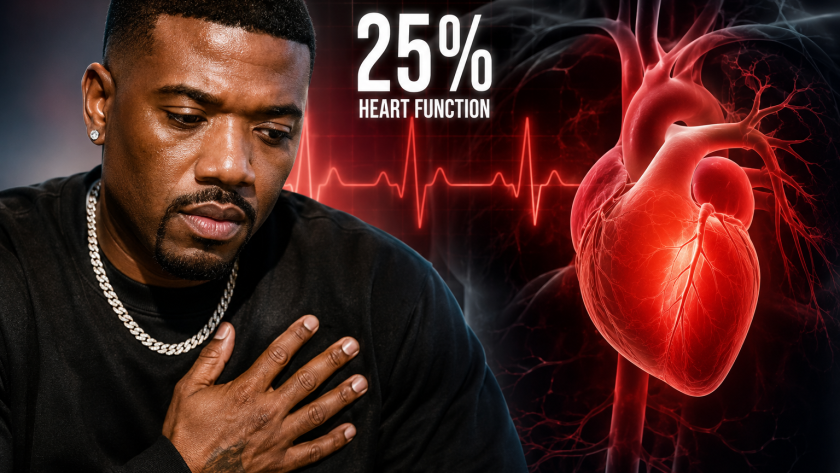
Ray J stood in front of his phone camera, still recovering from a hospital stay, and said something most people wouldn’t have the courage to admit publicly: his heart is only working at a quarter of its normal capacity.
“My heart’s only beating 25 percent, but as long as I stay focused and stay on the right path, everything will be all right,” the 45-year-old singer told fans in a January 25, 2026 Instagram video, after being hospitalized for severe pneumonia. In a caption on the same post, he added, “Just almost died!! I’m alive because of your prayers.”
For most people, “25 percent” doesn’t mean much out of context. But for cardiologists, it’s a number that changes everything. Here’s what actually happened to Ray J, what that number really means medically, and why this story is worth paying close attention to if you’re over 40 and have ever brushed off chest discomfort, breathlessness, or fatigue as “nothing.”
What Actually Happened to Ray J
On January 6, 2026, Ray J was admitted to a hospital in Las Vegas after experiencing pneumonia and chest pains. According to his mother, he initially believed it was a minor recurrence of pneumonia he’d previously battled in 2021. Doctors disagreed, and kept him overnight for observation.
Once admitted, Ray J underwent X-rays and an echocardiogram, followed by an angiogram that revealed significant damage to his heart. Doctors delivered the diagnosis: his heart was pumping at only 25 percent efficiency, a condition classified as severe heart failure.
In later videos that circulated online, Ray J shared an even more sobering detail: doctors reportedly told him his life expectancy could be limited if his condition doesn’t improve. “2027 is definitely a wrap for me,” he said in one clip. He also pointed directly to the cause, saying years of heavy alcohol and drug use had taken a visible toll on his heart. “I shouldn’t have went this hard, bro,” he said.
It’s worth being upfront about something here: unlike some celebrity health stories, Ray J’s situation isn’t a mystery illness or a random genetic risk. He’s been direct about the role his own lifestyle played in this outcome. That honesty is exactly what makes his story so valuable, because it shows, in real time, how the heart responds when it’s pushed past its limits for years.
What “25 Percent Heart Function” Actually Means
To understand why this number is so alarming to doctors, it helps to understand what it’s actually measuring: something called ejection fraction, which is the percentage of blood your heart pumps out with each beat.
A healthy heart typically has an ejection fraction between 50 and 70 percent. When that number drops below 35 percent, doctors consider the patient at high risk for life-threatening irregular heartbeats, and many patients in that range require an implantable defibrillator. The American Heart Association classifies this level as advanced heart failure, requiring aggressive treatment and significant lifestyle changes.
Ray J’s reported 25 percent puts him well within that high-risk range. In simple terms, his heart is having to work far harder than a healthy heart just to keep his body functioning normally, and it has very little reserve left if additional stress is placed on it, like another infection, physical exertion, or continued substance use.
Why Pneumonia Can Be So Dangerous for the Heart
One detail that often gets lost in the headlines is how directly pneumonia and heart health are connected. Pneumonia doesn’t just affect the lungs, it places significant strain on the entire cardiovascular system. When your lungs are inflamed and struggling to move oxygen into the bloodstream, your heart has to pump harder and faster to compensate.
For a heart that’s already weakened, whether from years of substance use, high blood pressure, or undiagnosed heart disease, this extra strain can be the tipping point that pushes it into failure. This is part of why doctors urge adults over 40, especially those with any existing risk factors, to treat respiratory infections seriously rather than waiting them out at home.
Heart Failure Warning Signs Adults Over 40 Should Never Ignore
Ray J’s story is dramatic, but the underlying symptoms of heart strain are often quiet and easy to dismiss. Doctors say these are the signs worth paying attention to, especially if more than one shows up at the same time:
- Shortness of breath, especially when lying down or during light activity
- Persistent fatigue that doesn’t improve with rest
- Swelling in the legs, ankles, or feet
- A rapid or irregular heartbeat
- Chest discomfort, tightness, or pressure
- A lingering cough, especially with pink or white mucus
- Sudden weight gain from fluid retention
Many people attribute these symptoms to simply “getting older” or “being out of shape.” But when they show up together, or persist for more than a few days, doctors consistently recommend getting evaluated rather than waiting to see if they pass on their own.
What Actually Supports Long-Term Heart Health
Ray J’s situation is extreme, but the underlying lesson applies broadly: the heart is resilient for a long time, until it isn’t. Cardiologists consistently point to a few foundational habits that make a measurable difference in long-term heart health:
- Limit or eliminate alcohol and recreational drug use, both of which place direct, cumulative strain on heart muscle over time.
- Treat respiratory infections seriously, especially pneumonia, and don’t wait to see a doctor if breathing feels labored.
- Support healthy blood flow and circulation through diet, movement, and targeted nutrients.
- Get regular cardiovascular checkups, particularly after 40, even if you feel fine.
- Manage blood pressure and cholesterol proactively, since both are major contributors to long-term heart strain.
This is one of the reasons so many people focused on heart health have started incorporating Cardio Miracle into their daily routine. It’s a nitric-oxide based formula specifically designed to support healthy blood flow, circulation, and cardiovascular function, the exact systems placed under extreme strain in situations like Ray J’s. Use code healthywildfree at checkout for a discount.
Alongside cardiovascular support, magnesium plays a critical, and often overlooked, role in heart rhythm regulation. Low magnesium levels have been directly linked to irregular heartbeat and increased cardiovascular strain. Magnesium Breakthrough offers a full-spectrum magnesium formula designed to support heart rhythm, muscle function, and better sleep, three factors that directly influence how well your heart recovers and functions long term. Use code healthywildfree at checkout.
The Bigger Picture
Ray J’s honesty about what led to his heart failure is rare, and it’s exactly what makes this story worth learning from rather than just reading about. Most people don’t get a warning this direct. Most hearts fail quietly, one ignored symptom at a time, long before anyone ends up in a hospital bed with an ejection fraction of 25 percent.
If you’ve been telling yourself that your fatigue, breathlessness, or irregular heartbeat is nothing to worry about, Ray J’s story is a hard reminder that the body keeps score, even when we’re not paying attention. Getting checked, cutting back on the habits that strain your heart, and supporting your cardiovascular system proactively costs far less than waiting for a wake-up call as serious as his.
We’re wishing Ray J strength and a full recovery.