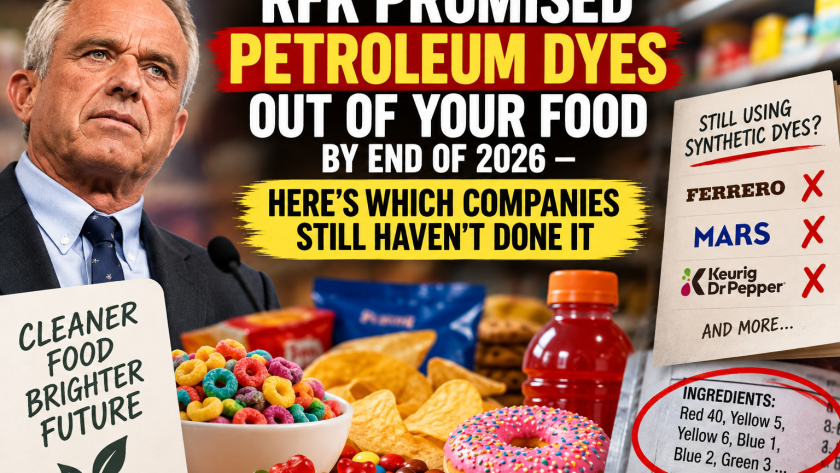
In April 2025, Health Secretary Robert F. Kennedy Jr. stood before cameras and made a promise that resonated with millions of parents and health-conscious shoppers: petroleum-based synthetic dyes would be phased out of America’s food supply by the end of 2026.
It sounded like a ban. For a lot of people, it felt like one. But as that deadline approaches, the reality on grocery store shelves tells a more complicated story, and it’s worth understanding exactly what was promised, what’s actually happened, and what’s still sitting in your pantry right now.
What Was Actually Promised
Here’s the detail that got lost in the headlines: the April 2025 announcement was never a ban. It was a voluntary understanding between HHS, the FDA, and the food industry. The FDA formally banned only two synthetic dyes that were already rarely used, Citrus Red 2 and Orange B, and has only proposed removing one of those from the approved list. The remaining six commonly used dyes, including Red 40, Yellow 5, Yellow 6, Blue 1, Blue 2, and Green 3, remain fully legal and approved for use today. FD&C Red No. 3 was banned separately by the Biden administration in January 2025, but that ban doesn’t take effect until 2027.
In other words, no company is legally required to remove any of these dyes. The entire plan rests on companies voluntarily choosing to act, and as of today, that’s exactly where the story gets uncomfortable.
Which Companies Actually Committed — And Which Didn’t
The Center for Science in the Public Interest built a tracker examining the 24 largest US food and beverage manufacturers and where each one stands. As of the most recent update, the results break down like this:
- 50 percent (12 companies) have pledged to remove synthetic dyes from all of their US products
- 4 percent (1 company) pledged partial removal, covering only some products
- 17 percent (4 companies) made vague statements without a clear scope or timeline
- 29 percent (7 companies) have made no public commitment at all
Two of the worst offenders by dye usage also happen to have made zero commitment. In 2020 data, Ferrero’s products contained synthetic dyes in 60 percent of its lineup, and Mars came in at 52 percent, both are currently listed with no plan in place. Keurig Dr. Pepper, at 31 percent dye usage, also has no public commitment.
On the other end, McKee Foods (maker of Little Debbie) and Hershey both pledged full removal across all products, despite starting from meaningfully high synthetic dye usage themselves.
The Industry’s History of Broken Promises
This isn’t the food industry’s first rodeo with dye pledges, and that history matters. Campbell’s, General Mills, Mars, Mondelez, and Kellogg’s all previously pledged to phase out synthetic colors during an earlier reformulation push roughly a decade ago. Those pledges were not fully delivered on.
That track record is a big part of why consumer advocates are skeptical this time will be different, especially given that the current plan carries even less enforcement power than the last one. There is no binding deadline, no penalty for non-compliance, and companies that miss the “end of 2026” date the public heard about face no consequences whatsoever.
Even trade groups representing major manufacturers have signaled where things are really headed. The National Confectioners Association, which represents companies like Ferrara Candy Company, Mars Wrigley, and Tootsie Roll, has stated that its members will simply follow whatever regulatory guidance is issued, language that consumer groups have interpreted as members not planning to act unless and until the FDA actually forces the issue. The Consumer Brands Association’s own pledge only commits to “encouraging” member companies to stop using dyes by the end of 2027, a full year past the date most consumers heard reported.
Why the Deadline Quietly Slipped to 2027
Here’s something most coverage of the original announcement didn’t make clear: even among companies that did make commitments, the real target date for many of them isn’t the end of 2026 people remember hearing. It’s the end of 2027. The FDA’s own industry pledge tracker reflects this shift, and industry groups like the International Dairy Food Association have publicly committed to a 2027 timeline for products like ice cream, not 2026.
For consumers who heard “phased out by end of 2026” and assumed that meant their grocery cart would look meaningfully different by the new year, this is worth knowing now, not after the deadline quietly passes.
What Still Contains These Dyes Right Now
Because there’s no ban and no unified timeline, the honest answer is that a significant number of everyday grocery products still contain Red 40, Yellow 5, Yellow 6, and other synthetic dyes as of today. Companies without a commitment, and even many companies with a “some products” or “unclear” commitment, likely still have dyed products on shelves in your local store.
The most reliable way to know for certain is to check the ingredient label directly. Synthetic dyes are required to be listed by name, so scanning the ingredient panel remains the most accurate tool available to consumers right now, regardless of what any company has pledged publicly.
Why This Matters for Your Health
This isn’t just a corporate accountability story, it’s a real health question for families. A comprehensive scientific review published by California’s Office of Environmental Health Hazard Assessment found that the most widely used synthetic dyes can cause or worsen neurobehavioral problems, including hyperactivity, inattentiveness, and restlessness, in some children. The same review raised concerns that the FDA’s current safety thresholds for these dyes may not adequately protect kids, in part because the original studies used to set those limits weren’t designed to detect these effects in the first place.
For adults, especially those managing existing sensitivities or trying to reduce processed food intake generally, avoiding synthetic dyes is part of a broader pattern of reducing ultra-processed ingredients tied to inflammation and long-term metabolic health.
What You Can Actually Do About It
Given that enforcement is essentially nonexistent right now, the most reliable path is simply becoming a more careful label reader:
- Check ingredient labels directly, rather than trusting a company’s general public pledge
- Watch for Red 40, Yellow 5, Yellow 6, Blue 1, Blue 2, and Green 3 by name on the ingredient panel
- Favor whole, minimally processed foods where dyes are rarely a concern to begin with
- Check your state’s laws — several states, including California, West Virginia, Texas, and Louisiana, have passed their own dye restrictions or labeling requirements that may offer more protection than federal action currently does
- Support brands that have already fully committed, since your purchasing choices are currently one of the only real levers being applied to hold companies accountable
Since so much of this comes down to what’s actually in your food, many households have also started paying closer attention to filling nutritional gaps with cleaner, third-party-tested supplements rather than relying on fortified processed foods. Codeage offers a range of clean-label supplements formulated without synthetic dyes or unnecessary additives, for anyone looking to reduce their overall exposure to unnecessary processed ingredients. Use code HEALTHYWILDFREE10 at checkout.
The Bottom Line
RFK Jr.’s April 2025 announcement created a strong public impression that synthetic dyes were being banned. What actually exists is a voluntary, unenforceable request, one that roughly a third of major food manufacturers haven’t even formally responded to, and one where even many “commitments” quietly push the real deadline to 2027 rather than the 2026 date the public remembers hearing.
The most reliable protection right now isn’t a corporate pledge or a federal deadline. It’s reading the label yourself, every time, until the law actually catches up to the promise.