Pennsylvania is in the middle of its largest measles outbreak in decades. As of September 11, 2026, state health officials have confirmed 676 cases across 37 counties, with 124 people hospitalized. Three people have died. And for weeks, the basic facts of those deaths have been the subject of an unusually public, unusually bitter dispute between the state’s governor and the nation’s top health official.
This isn’t a story about whether you should or shouldn’t vaccinate. It’s a story about something your audience cares about just as much: what happens when the people in charge of telling you the truth about a public health crisis start disagreeing, loudly, about the basic facts. Here’s the complete, sourced timeline, followed by an honest look at what the evidence actually supports for supporting your family’s health either way.
Watch the Full Investigation Before You Read On
Before getting into the full timeline, there’s a documentary that explores this broader pattern of institutional trust and public health messaging in more depth than a single article can. Worth watching alongside this piece.
Click here to watch the MAHA film free
Click here to watch the MAHA film free
The Full Timeline
April 2026. Pennsylvania’s outbreak begins, eventually growing into the state’s largest in 35 years.
August 26, 2026. Pennsylvania Health Secretary Dr. Debra Bogen announces the state’s first two measles-associated deaths, both unvaccinated Lancaster County residents. One is later confirmed to be a newborn. The state health department has since clarified that a death is classified as “measles-associated” when there is laboratory or epidemiological evidence linking measles to the death, not necessarily that measles was the sole cause.
Later that week. Details on the two deaths emerge. According to the New York Times, one case involved a newborn whose immediate cause of death was a lacerated spleen; because the baby tested positive for measles, and because measles is known to make the spleen more vulnerable to injury, the state recorded the death as measles-associated. A separate report indicated a 6-week-old girl’s death, in Lancaster County, involved a pre-existing fatal genetic condition alongside a measles infection.
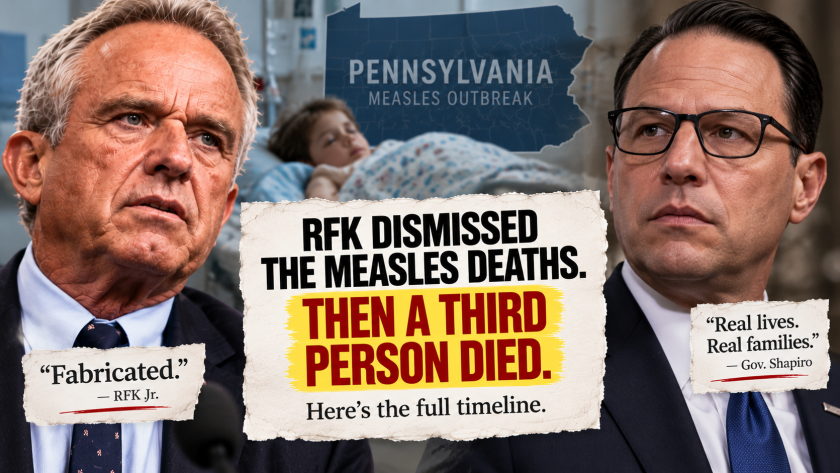
Late August 2026. Kennedy publicly disputes the deaths. In a post on X from his official government account, he wrote that Shapiro’s announcement “appears to have been premature, and the deaths may even have been altogether fabricated by one of the Governor’s hopeful staffers.” He cited a claim that the Lancaster County Coroner had “no record of any measles deaths,” and argued the state was not cooperating with the CDC. Pennsylvania officials said they had been in regular contact with the CDC throughout the outbreak.
Kennedy escalates further. In a Fox News interview, Kennedy referred to the deaths as “so-called measles deaths” and accused Shapiro of running “a replay of the Democrats’ COVID playbook,” drawing a direct comparison to his long-standing claims that COVID-19 death counts had been inflated by counting people who died of other causes while testing positive for the virus.
Shapiro responds. The governor said he was frustrated that, at a moment when he needed the country’s top health official to responsibly help manage a real outbreak, Kennedy instead pursued what Shapiro called conspiracy theories and false claims. Dr. Bogen, a pediatrician with more than three decades of clinical experience, publicly disputed Kennedy’s characterization of the deaths without directly naming him.
The CDC weighs in, awkwardly. The CDC’s official X account responded to the dispute by saying it appreciated “Secretary Kennedy’s efforts to clarify conflicting information” and that the agency was “working to determine what actually occurred,” while also stating Pennsylvania had declined offers of federal assistance. Pennsylvania’s health department called the CDC’s characterization inaccurate, stating it remained in regular contact with CDC professional staff throughout.
September 12, 2026. A third death is reported. A 40-year-old unvaccinated woman from Jefferson County dies from what the county coroner’s office describes as “complications associated with measles.” This is a different, more rural county from the first two deaths, and a different demographic entirely, an adult rather than an infant.
An important nuance emerges almost immediately. Unlike the first two deaths, this case carries real diagnostic uncertainty. According to reporting on the woman’s death certificate, she was never tested for measles; the certificate lists suspected measles alongside chronic obstructive pulmonary disease (COPD) and asthma as contributing conditions. The Pennsylvania Department of Health has said it is reviewing the case rather than confirming it outright.
The state-federal gap continues. As of publication, the CDC’s national measles data still shows zero confirmed 2026 measles deaths in its official count, noting that the National Center for Health Statistics has no 2026 death records listing measles as the underlying cause, and that it’s working with state epidemiologists on a standardized case definition. CDC Director Dr. Erica Schwartz has stated the agency was not notified of the third death by Pennsylvania officials, and that the state has not requested a CDC Epi-Aid, which would deploy federal epidemiologists to assist directly. Pennsylvania officials maintain they provided the required epidemiological data on the earlier deaths.
What’s Actually in Dispute, and What Isn’t
This is the part that matters most for evaluating the story honestly. A few things are not seriously in dispute: Pennsylvania is experiencing a real, large outbreak, 676 confirmed cases is not a small number, and it’s concentrated overwhelmingly among unvaccinated residents. Only 4 of the 676 confirmed cases were in fully vaccinated individuals, and none of those four required hospitalization.
What is genuinely in dispute is more specific: whether measles was the direct cause of death in each individual case, versus a contributing factor alongside other serious conditions, and whether the state’s classification standard, “measles-associated” rather than requiring measles as the sole listed cause, is being applied consistently and transparently. That’s a legitimate methodological question, one public health experts have noted is similar to disputes that arose during COVID-19 over how deaths “with” versus “from” a virus should be counted. It is not the same claim as “the deaths were fabricated,” an assertion for which no evidence has been presented publicly by anyone involved in this dispute, including Kennedy himself.
A Media Literacy Framework for Stories Like This
When public officials disagree this sharply about basic facts, here’s a practical way to evaluate what you’re seeing, regardless of which side you’re inclined to trust more:
- Separate the classification dispute from the outbreak’s existence. Whether a specific death should be counted as “measles-associated” or not doesn’t change whether 676 people in Pennsylvania have confirmed measles infections. Those are two different questions.
- Look for what’s independently verifiable. The case count and hospitalization numbers come from Pennsylvania’s own public health data and have not been seriously disputed by anyone in this story. The cause-of-death classifications for specific individuals are the part genuinely under dispute.
- Notice when a claim escalates without new evidence. Kennedy’s claim moved from “premature” to “fabricated” without any new evidence being publicly presented between those two statements. That escalation pattern, a stronger claim without stronger evidence, is worth noticing regardless of who’s making it.
- Watch for who has access to the underlying data. Much of this dispute traces back to disagreements over information sharing between state and federal officials. When two authorities disagree and neither has published the full underlying case data publicly, that’s a reason for real caution before fully accepting either side’s framing.
- Distinguish between an institution’s overall credibility and a specific factual claim. You can trust that Kennedy has been right about other issues, like food dye reform, and still evaluate this specific claim on its own evidence. The same applies in reverse for state officials.
What the Evidence Actually Supports for Immune Health
Regardless of where you land on the political dispute, supporting your family’s immune resilience is something within your control. It’s worth being precise here, since exaggerated claims in either direction don’t serve your family well.
Vitamin A does have a genuine, well-established role in measles treatment specifically, the World Health Organization recommends vitamin A supplementation for children diagnosed with measles, administered under medical supervision, since vitamin A deficiency is associated with more severe measles complications and vitamin A treatment has been shown to reduce mortality in diagnosed cases. This is different from using vitamin A as a general preventive measure, and it’s important to know that vitamin A can be toxic at high doses. If someone in your family is diagnosed with measles, talk to a doctor about appropriate vitamin A treatment rather than self-dosing.
Vitamin D plays a well-documented, broader role in normal immune function, and deficiency is common, particularly in people who spend limited time outdoors or live at higher latitudes.
Zinc similarly supports normal immune response and is one of the more evidence-backed nutrients for general immune health, though like vitamin A, more is not automatically better, and doses well above the recommended daily allowance can cause their own problems.
Vaccination status is the single factor most strongly associated with outcomes in this specific outbreak, according to Pennsylvania’s own public data: 4 of 676 cases occurred in fully vaccinated people, with zero hospitalizations among them. That’s a factual data point from this specific outbreak, not a political statement, and it’s worth weighing alongside whatever personal or medical considerations inform your own family’s decisions.
Supporting General Immune Health
For households focused on foundational immune support, a few options worth knowing about:
HealthyCell offers a broad-spectrum daily multivitamin that includes vitamin D, zinc, and other nutrients tied to normal immune function, designed to help cover common dietary gaps. Use code healthywildfree at checkout.
Sovereign Silver is a product many households incorporate as part of a general daily wellness routine, particularly during periods of higher illness circulation in their community. Use code Healthywildfree10 at checkout.
To be direct about the limits here: none of these products treat, prevent, or cure measles, and none are a substitute for medical care if you or a family member has been exposed or is showing symptoms. If you suspect measles exposure, contact a healthcare provider promptly, both for your own care and because measles is highly contagious and early reporting helps public health officials track outbreaks accurately.
The Bigger Picture on MAHA’s Credibility
This story sits at an uncomfortable intersection for Kennedy’s broader movement. His food policy work, pushing synthetic dye removal, ultra-processed food scrutiny, and food additive transparency, has drawn support even from people skeptical of his other positions, because it’s generally been grounded in citable, reviewable evidence. His public dispute over the Pennsylvania measles deaths has followed a different pattern: escalating claims made publicly, without corresponding public evidence, in the middle of an active, worsening outbreak.
That distinction matters for anyone trying to evaluate MAHA’s claims fairly going forward, on a case-by-case basis rather than treating every statement from the movement as equally well-supported. Some of it is. This particular dispute, as of publication, is not.
The Bottom Line
Pennsylvania’s measles outbreak is real, large, and overwhelmingly affecting unvaccinated residents. Three deaths have been reported, with genuine, documented uncertainty around the classification of at least one, and a real, ongoing dispute between state and federal officials over how transparently the underlying data has been shared. What hasn’t emerged, despite Kennedy’s public claims, is any actual evidence that the deaths were fabricated. Readers deserve the full, honest picture, uncertainty included, rather than a version flattened to fit either side’s preferred narrative.