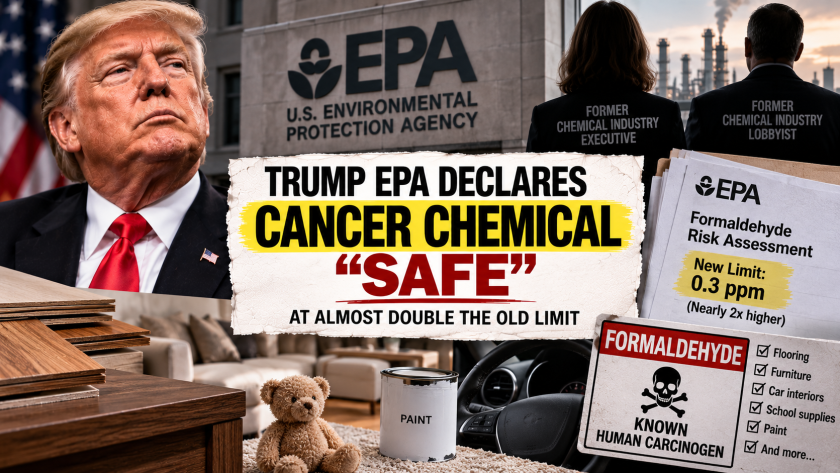
Formaldehyde isn’t an obscure industrial chemical you’ll never encounter. It’s in your flooring, your furniture, your car’s interior, your kids’ school supplies, and the paint on your walls. For decades, regulators treated it as a substance with no truly safe level of exposure, a known human carcinogen linked to leukemia and cancers of the nose, throat, and sinuses. On December 3, 2025, the EPA proposed changing that, in a way that critics say tracks almost exactly with what the chemical industry has been asking for since at least 2022.
Watch the Full Investigation Before You Read On
Before getting into the details of what changed and who made the decision, there’s a documentary that covers this same pattern of industry influence over public health policy in more depth than a single article can. Worth watching alongside this piece.
Click here to watch the MAHA film free
Click here to watch the MAHA film free
What the EPA Actually Changed
On December 3, 2025, the EPA’s Office of Chemical Safety and Pollution Prevention released an updated draft risk calculation for formaldehyde under the Toxic Substances Control Act. The revision does two significant things.
First, it adopts a new “point of departure” of 0.3 parts per million, nearly double the threshold finalized by the Biden administration in January 2025. Second, and more fundamentally, it shifts the underlying scientific framework used to assess formaldehyde’s cancer risk entirely. Instead of treating formaldehyde the way regulators have treated known carcinogens for decades, as a substance where any exposure carries some incremental cancer risk, the new approach adopts a “threshold” model, one that assumes there’s a specific exposure level below which cancer risk is effectively zero.
This distinction matters enormously. The prior approach, used across the last four presidential administrations regardless of party, is grounded in a well-established scientific principle that genotoxic carcinogens, chemicals capable of directly damaging DNA, don’t have a truly “safe” floor, because even small amounts of DNA damage carry some risk. The new approach essentially argues that below a certain exposure level, the body’s own repair mechanisms handle any damage adequately, and no meaningful cancer risk exists.
The American Chemistry Council’s own review of the EPA’s revised memo found it aligned closely with comments submitted by the trade group’s Formaldehyde Panel back in May 2024, an analysis that specifically noted the EPA had adopted the industry-preferred threshold model, the industry’s position that formaldehyde doesn’t follow a well-established toxicology principle called Haber’s Law, and the industry’s advocated occupational exposure limit of exactly 300 parts per billion.
The Officials Behind the Decision
Here’s where this story moves from a technical regulatory dispute to a genuine conflict-of-interest question. According to ProPublica’s reporting, the formaldehyde reassessment was shaped substantially by two EPA officials who spent significant portions of their careers working directly for the chemical industry’s main trade group.
Lynn Dekleva is now deputy assistant administrator of the EPA’s Office of Chemical Safety and Pollution Prevention, the exact division responsible for the formaldehyde assessment. Before joining the EPA, Dekleva served as senior director of the American Chemistry Council’s chemical products and technology division. As recently as 2022, in that role, she personally wrote to an EPA scientist advocating for the same threshold-based approach the agency has now adopted. At the time, the EPA explored that suggestion and rejected it, a decision the National Academies of Sciences, Engineering and Medicine independently reviewed and supported.
Nancy Beck is principal deputy assistant administrator at the same division, and her name appears on the official agency memo outlining the new revisions. Beck also previously worked for the American Chemistry Council.
In plain terms: the same argument a chemical industry trade group representative made to the EPA in 2022, and which the agency rejected at the time, is now the official position of the EPA, implemented by the same person who made that original argument, now working inside the agency itself.
How Critics and Independent Experts Have Responded
The response from environmental and public health groups has been sharp and specific. Jonathan Kalmuss-Katz, an attorney at Earthjustice, put it directly: the underlying science on formaldehyde hasn’t changed, these are the same arguments the chemical industry has been making for a decade, and the only real difference is that an administration has finally been willing to act on them over its own scientists’ objections.
Maria Doa, director at the Environmental Defense Fund, said the revision ignores the EPA’s own established cancer risk guidelines and selectively adopts only the positions the chemical industry has spent years lobbying for.
The pushback hasn’t stayed confined to advocacy groups either. In February 2026, California Attorney General Rob Bonta joined a multistate coalition submitting a formal comment letter opposing the EPA’s revised calculation, arguing it underestimates formaldehyde’s actual cancer risk and would undermine the agency’s own prior assessments if finalized. That letter cited the EPA’s own 926-page Toxicological Review of Formaldehyde, released in August 2024 after 35 years of research, which concluded formaldehyde is carcinogenic to humans via inhalation and that children face particular vulnerability to its respiratory effects.
It’s worth noting that not every credentialed scientist has opposed the change. Dennis Paustenbach, chief scientist at the consulting firm TRC, told Chemical & Engineering News he welcomed the EPA’s revisited approach, arguing the proposed occupational exposure limit would protect an estimated 90 percent of the population, including people with asthma, even across a full eight-hour workday. The American Chemistry Council itself has stated its position is grounded in what it calls the weight of scientific evidence, including newer modeling research it argues shows certain tumor types in animal studies can result from cell damage alone rather than direct genetic mutation. Whether that modeling should outweigh three and a half decades of prior risk assessment is exactly the scientific dispute now playing out in public comments and, likely, future litigation.
Why This Matters Beyond the Regulatory Language
This isn’t a purely academic dispute. Once the EPA finalizes a risk assessment for a chemical like formaldehyde, federal law generally preempts individual states from setting their own, potentially stricter, protections for that same chemical. In other words, this single decision, made substantially by two people with direct prior employment ties to the industry being regulated, could set the ceiling for formaldehyde protection nationwide, regardless of what any individual state might otherwise choose to do.
Where Formaldehyde Actually Shows Up in Your Home
Understanding why this policy matters requires understanding just how common formaldehyde exposure already is in everyday life. It’s used as a binding agent in pressed-wood products like particleboard, plywood, and medium-density fiberboard, common in furniture, cabinetry, and flooring. It’s found in some paints, varnishes, and adhesives. It’s released by certain fabrics and textiles, particularly those treated for wrinkle resistance. It’s present in some cosmetics and personal care products as a preservative, and it’s emitted by combustion sources, including gas stoves and tobacco smoke.
Indoor air, where most people spend the vast majority of their time, frequently has meaningfully higher formaldehyde concentrations than outdoor air specifically because of how many common household products off-gas the chemical, particularly when new.
What the Health Research Actually Shows
It’s worth being specific about what regulators have spent decades documenting, since that’s the baseline this new threshold model is departing from. The EPA’s own 2020 Air Toxics Screening Assessment found formaldehyde poses a greater cancer risk than any other toxic air pollutant tracked nationally. It’s classified as a genotoxic carcinogen, meaning it has the demonstrated ability to directly damage genetic material, a classification that’s part of why the traditional “no safe threshold” approach was applied to it in the first place, the same logic applied to other genotoxic carcinogens like certain forms of asbestos and benzene.
At lower exposure levels, before any cancer risk enters the picture, formaldehyde is also a well-documented acute irritant, causing eye, nose, and throat irritation, coughing, and worsened symptoms for people with asthma or other respiratory conditions. Children are considered particularly vulnerable to these respiratory effects, according to the EPA’s own 2024 toxicological review, both because of their smaller airways and because they tend to breathe more air relative to their body size than adults do.
How to Reduce Formaldehyde Exposure in Your Home
Regardless of how this specific regulatory fight resolves, there are concrete, well-supported steps for reducing your household’s formaldehyde exposure:
- Choose solid wood or formaldehyde-free pressed wood products when buying furniture or flooring. Look specifically for products labeled CARB Phase 2 compliant or certified to meet formaldehyde emission standards.
- Increase ventilation, especially with new furniture or after renovations. Formaldehyde off-gassing is typically highest when products are new, so extra ventilation during the first several weeks after a purchase meaningfully reduces cumulative exposure.
- Maintain moderate indoor humidity and temperature. Formaldehyde off-gassing increases with heat and humidity, so keeping indoor conditions moderate can reduce emission rates from existing materials.
- Avoid smoking indoors, since tobacco smoke is a significant formaldehyde source.
- Choose low-VOC paints, adhesives, and finishes when renovating or furnishing your home.
- Consider an air purifier with activated carbon filtration, since standard HEPA filtration alone doesn’t effectively capture gaseous chemicals like formaldehyde, but activated carbon media does.
- Test your home’s indoor air quality directly if you have specific concerns, particularly after major renovations or new furniture purchases, using an indoor air quality monitor or a professional testing service.
Supporting Clean Air and Reduced Chemical Exposure at Home
For households looking to actively reduce indoor air pollutants, including formaldehyde and other volatile organic compounds, Air Doctor offers air purification systems designed with activated carbon filtration specifically targeting gaseous chemical pollutants that standard HEPA filters don’t fully address.
For households focused on reducing overall chemical exposure through cleaning products, which can compound formaldehyde exposure from other sources, Truly Free offers cleaning products formulated without many of the synthetic chemicals found in conventional cleaners.
The Bottom Line
The EPA is preparing to nearly double how much formaldehyde it considers safe to inhale, guided substantially by two officials who previously worked for the trade group representing the companies that manufacture and profit from formaldehyde-based products. That’s not a claim requiring speculation, it’s documented in the officials’ own employment histories and, in Dekleva’s case, her own prior written advocacy to the agency she now helps run. Whether the underlying science genuinely supports a threshold model, as industry-aligned scientists argue, or whether this represents a straightforward case of regulatory capture, as environmental attorneys and a coalition of state attorneys general argue, is likely to be fought out through the public comment process and, quite possibly, the courts, in the months ahead.
In the meantime, reducing your own household’s formaldehyde exposure doesn’t require waiting for that fight to resolve. This is a story worth following closely, since the EPA’s next step is to finalize a rule addressing what it determines to be formaldehyde’s “unreasonable risk” under federal law, a determination that, once made, has real, lasting consequences for what protections exist, or don’t, nationwide.