What if government health officials found alarming safety signals regarding a routine childhood medical intervention… and then quietly met behind closed doors to discuss it?
For over two decades, a fierce and highly emotional debate has raged in the shadows of the internet, in congressional hearings, and at kitchen tables across the world. At the center of this storm is a viral claim: In 1999, preliminary data from the Centers for Disease Control and Prevention (CDC) allegedly showed that babies receiving the Hepatitis B vaccine in their first month of life faced a massive, terrifying increase in the risk of developing autism.
Shortly after this data emerged, top health officials, researchers, and pharmaceutical representatives allegedly gathered at a secluded retreat center in Georgia for a secret meeting. Critics claim the data was systematically buried, manipulated, and scrubbed from public view to protect the multi-billion-dollar vaccine industry.
Did this really happen? Did the government uncover a catastrophic error in the childhood immunization schedule and hide it from the public? Or is the true story—a complex tale of early statistical “noise,” evolving epidemiological methods, and a public relations disaster—much more complicated?
To understand the truth, we must strip away the modern political rhetoric, open the original transcripts, and step back into the chaotic scientific landscape of the year 1999.
What Was the 1999 CDC Data?
To understand the explosive nature of the 1999 data, you first must understand where it came from. The CDC monitors vaccine safety through a massive, interconnected database known as the Vaccine Safety Datalink (VSD). The VSD pools electronic health records from millions of patients across various large Health Maintenance Organizations (HMOs) in the United States. It allows researchers to track who received which medical treatments and whether they subsequently developed specific health conditions.
In the late 1990s, public health officials were growing concerned about thimerosal, a mercury-based preservative used in several childhood vaccines, including the Hepatitis B vaccine. Because the childhood immunization schedule had expanded over the decade, infants were receiving more thimerosal in their first six months of life than ever before.
In 1999, a CDC epidemiologist named Dr. Thomas Verstraeten was tasked with analyzing the VSD database to see if there was any statistical association between early exposure to thimerosal-containing vaccines and neurodevelopmental disorders, such as autism, speech delays, and ADHD.
The Claim of a 1,135% Increased Risk
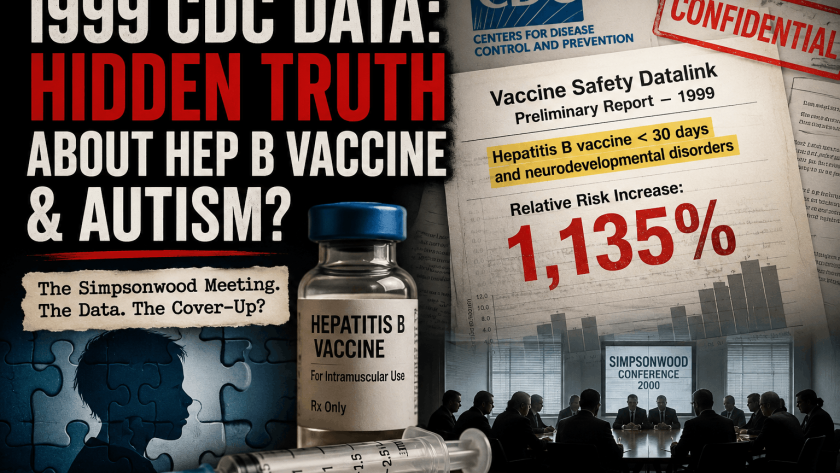
When Dr. Verstraeten ran the very first phase of his analysis, the raw numbers were staggering. The initial computer run suggested a massive statistical association. According to FOIA-released documents from this early phase, the data showed a Relative Risk (RR) of 11.35 for autism in children who received the highest doses of thimerosal in their first month of life compared to those with zero exposure.
In statistical terms, a Relative Risk of 1.0 means there is zero difference between two groups. An RR of 11.35 translates to a 1,135% increased risk.
When modern critics reference the “hidden CDC vaccine data,” this is the specific number they are pointing to. However, understanding what this number actually represented requires a deep dive into the mechanics of epidemiology.
This initial run was not a finalized, peer-reviewed conclusion of causation. It was a preliminary statistical “signal.” In vast databases like the VSD, researchers frequently find terrifying associations on the first run of raw data. Why? Because raw data does not account for confounding variables. It merely asks a computer: Did group A have a higher rate of condition X than group B? It does not explain why.
The Simpsonwood Meeting Explained
Faced with this alarming preliminary signal, the CDC did not immediately publish a press release—a decision that would later fuel decades of conspiracy theories. Instead, they convened an emergency gathering of top experts to figure out what the data actually meant.
In June 2000, over 50 experts gathered at the Simpsonwood Retreat Center, a secluded Methodist conference center nestled in the woods of Norcross, Georgia. Attendees included top CDC officials, representatives from the Food and Drug Administration (FDA), the World Health Organization (WHO), independent toxicologists, and executives from major pharmaceutical companies that manufactured vaccines.
Was It a “Secret” Meeting?
Critics frequently describe Simpsonwood as a secret, clandestine cabal. The CDC, however, argues it was a standard scientific working group. The meeting was not publicly announced because the data being discussed was highly preliminary, unpublished, and heavily embargoed. In the scientific community, holding a closed-door peer-review session to scrutinize alarming raw data before triggering a potential global public health panic is standard operating procedure.
However, thanks to the Freedom of Information Act (FOIA), the 286-page transcript of the Simpsonwood meeting was eventually released to the public. The transcript provides a fascinating, unvarnished look at scientists grappling with frightening data in real-time.
What the Transcripts Actually Showed
The Simpsonwood transcripts do not show a room full of evil caricatures plotting to poison children. Instead, they show a room full of highly anxious scientists aggressively debating the methodology of Dr. Verstraeten’s findings.
Some experts in the room were deeply troubled by the signal. Dr. Richard Johnston, an immunologist and pediatrician, famously stated on the record:
“My mandate as I sit here in this group is to make sure at the end of the day that 100,000, 100 million, not one, not one U.S. infant get one more drop of weight of thimerosal… I do not want my grandson to get a thimerosal-containing vaccine until we know what is going on.”
Dr. Verstraeten himself expressed frustration during his presentation, noting that no matter how he initially sliced the data to try and make the statistical signal disappear, the association with speech delays and tics remained stubbornly present. “It just won’t go away,” he noted in internal communications.
However, other experts in the room pointed out massive, glaring flaws in the preliminary data. They argued that the sample sizes in certain cohorts were far too small to draw conclusions and that the data suffered from severe biases.
Protecting Your Family’s Neurological Health
Regardless of where one stands on the historical debates surrounding 1990s medical protocols, the conversation around thimerosal highlighted a very real, enduring public concern: the impact of environmental heavy metals and toxins on the developing human brain. Today, our neuro-exposure extends far beyond the doctor’s office. Heavy metals, microplastics, and industrial chemicals routinely contaminate our municipal tap water, acting as silent neuro-disruptors that can impact cognitive development and long-term brain health.
You cannot control the history of federal health policy, but you have absolute control over the environmental purity of your own home. To proactively protect your family’s neurological terrain from modern industrial toxins, securing your daily water supply is the absolute first step. Clearly Filtered water pitchers utilize proprietary, advanced affinity filtration technology that is independently tested to strip out up to 99.9% of heavy metals (including lead and arsenic), fluoride, and PFAS “forever chemicals” that standard charcoal filters leave behind. Take command of your biological environment today.
👉 Secure Your Clearly Filtered Clean Water System Here
Did the CDC “Bury the Data”?
Following the Simpsonwood meeting, the narrative takes a sharp turn. Over the next three years, Dr. Verstraeten and his team continued to analyze the VSD data. They added more recent health records from different HMOs to increase the sample size. More importantly, they began to adjust the data for a massive confounding variable known as “healthcare-seeking behavior.”
In epidemiology, researchers know that parents who strictly adhere to the childhood vaccination schedule are also significantly more likely to bring their children to the doctor for regular check-ups, developmental screenings, and early-intervention behavioral assessments. Conversely, parents who skip or delay vaccines often utilize the healthcare system less frequently.
Therefore, a child who receives all their vaccines on time is far more likely to receive an early diagnosis for a speech delay or autism, simply because they are being observed by pediatricians more often. When Verstraeten’s team mathematically adjusted the raw data to account for this healthy-user bias, the massive 1,135% increased risk evaporated. The statistical signal dropped closer to zero.
When the final study was published in the journal Pediatrics in 2003, it concluded that there was no consistent, significant link between thimerosal-containing vaccines and autism.
The Birth of a Conspiracy
To critics, this looked exactly like a cover-up. They saw a terrifying raw number in 1999, followed by a closed-door meeting with pharmaceutical executives, followed by years of “massaging the data” until the problem miraculously disappeared. Adding explosive fuel to the fire, shortly after completing the analysis, Dr. Verstraeten left the CDC to take a lucrative job at GlaxoSmithKline, one of the world’s largest vaccine manufacturers.
To the skeptical public, the timeline was damning. But to the epidemiological community, this is simply how the scientific method operates: you find a terrifying anomaly in raw data, you scrutinize it, you expand the sample size, you adjust for human behavioral biases, and the true picture emerges.
What Do Later Large-Scale Studies Say?
If the 1999 CDC data was the only research ever conducted on the Hepatitis B vaccine, thimerosal, and autism, the public would have every right to remain deeply suspicious. However, the controversy triggered one of the most massive, globally coordinated scientific investigations in modern medical history.
Over the last twenty years, independent researchers across the world have attempted to find a link between the Hepatitis B vaccine, thimerosal, and autism. The results have been overwhelmingly uniform.
The Real-World Thimerosal Test
In the early 1990s, several countries, including Denmark and Japan, completely removed thimerosal from their childhood vaccines out of an abundance of caution. If the thimerosal in the Hepatitis B and DTaP vaccines was truly the primary driver of the autism epidemic, the removal of the preservative should have resulted in a massive, immediate plunge in autism rates in those countries.
That did not happen. In fact, a landmark 2003 study analyzing the Danish psychiatric registry found that autism rates continued to rise steeply in the exact same trajectory after thimerosal was removed from their national vaccine supply.
The Independent Reviews
In 2004, the Institute of Medicine (IOM)—an independent, non-governmental advisory group of elite scientists—conducted an exhaustive review of all global epidemiological data regarding vaccines and autism. Their conclusion was definitive: the evidence favored a rejection of a causal relationship between thimerosal-containing vaccines and autism.
Dozens of subsequent meta-analyses involving millions of children across multiple continents have consistently arrived at the same conclusion. The original 1999 VSD signal was a statistical artifact, a ghost in the machine born of small initial sample sizes and unadjusted behavioral data.
Reclaiming Cognitive Sovereignty
While the scientific consensus has ruled out routine childhood immunizations as the cause of cognitive decline, the reality is that millions of adults still struggle daily with brain fog, processing delays, and a lack of mental clarity due to modern environmental stress, poor sleep architecture, and nutrient-depleted diets.
If you are looking to optimize your neural pathways and provide your brain with the uncompromised raw materials it needs to fire efficiently, you must focus on premium synaptic fuel. Iso Alpha is engineered specifically for elite brain health, utilizing a highly bioavailable matrix of neuro-nutrients designed to defend against cellular oxidative stress and support robust cognitive processing speed. By upgrading your daily routine with precision brain nutrition, you can push back against mental fatigue and reclaim your sharp, articulate edge.
👉 Fortify Your Brain Health with Iso Alpha Here (Use the exclusive discount code healthywildfree at checkout to unlock your savings).
Why This Debate Still Matters
It is easy for modern public health officials to look back at the Simpsonwood meeting and dismiss the ensuing controversy as anti-science paranoia. But doing so ignores a crucial lesson in public trust.
The CDC autism controversy was, fundamentally, a catastrophic failure of transparency and communication. When a government agency discovers alarming preliminary data, holds an unannounced meeting with industry executives, takes three years to publish the “adjusted” findings, and watches its lead researcher walk through the revolving door into a pharmaceutical corporation, skepticism is not just understandable—it is a rational human response.
This debate continues to matter because it highlights the fragile nature of public trust in institutional medicine. When people feel that their questions are being mocked, or that financial conflicts of interest are being swept under the rug, they will naturally seek out alternative explanations.
The Simpsonwood meeting is a masterclass in how not to handle a public health scare. Even though the science ultimately exonerated the vaccine schedule, the optics of the investigation planted seeds of doubt that have grown into a massive movement of modern medical skepticism. It is a reminder that in public health, transparency is just as important as accuracy.
Separating the Signal from the Noise
So, did the CDC hide a link between the Hepatitis B vaccine and autism?
When we step back and examine the totality of the evidence without the filter of political propaganda, the answer is no. The government did not hide a proven link, because a causal link was never proven.
What the CDC did do was stumble upon a terrifying statistical anomaly in the early days of electronic health tracking. They panicked, called an emergency meeting, debated the flaws in the data behind closed doors, and spent years refining their mathematical models until the terrifying signal vanished.
There was absolutely enough preliminary evidence in 1999 to justify immense concern. The scientists in the Simpsonwood retreat were right to be afraid, and they were right to scrutinize the data aggressively. But the hallmark of the scientific method is the ability to test a hypothesis against reality. When the thimerosal hypothesis was tested against the reality of millions of children across Denmark, Japan, and the United States, the link completely fell apart.
The story of the Simpsonwood meeting is not a story of a successful government cover-up. It is the story of how messy, confusing, and terrifying the scientific process can look while it is happening in real-time.
As we navigate modern health choices, it is vital to maintain a fierce, independent curiosity. We must demand absolute transparency from regulatory agencies, aggressively question conflicts of interest, and read primary source documents for ourselves. But we must also possess the intellectual honesty to distinguish between an unanswered question and a proven fact, recognizing when a terrifying early warning sign turns out to be nothing more than a ghost in the data.